
Cheapside Street
 Agas MapList documents mentioning Cheapside Street
- A Remembrance of the Worthy Show and Shooting by the Duke of Shoreditch
- Aldersgate Ward
- Baynard’s Castle
- Bordhaw Lane
- Bow Lane
- Bread Street
- Candlewick Street Ward
- Carey Lane
- Cheap Ward
- Cheapside Cross (Eleanor Cross)
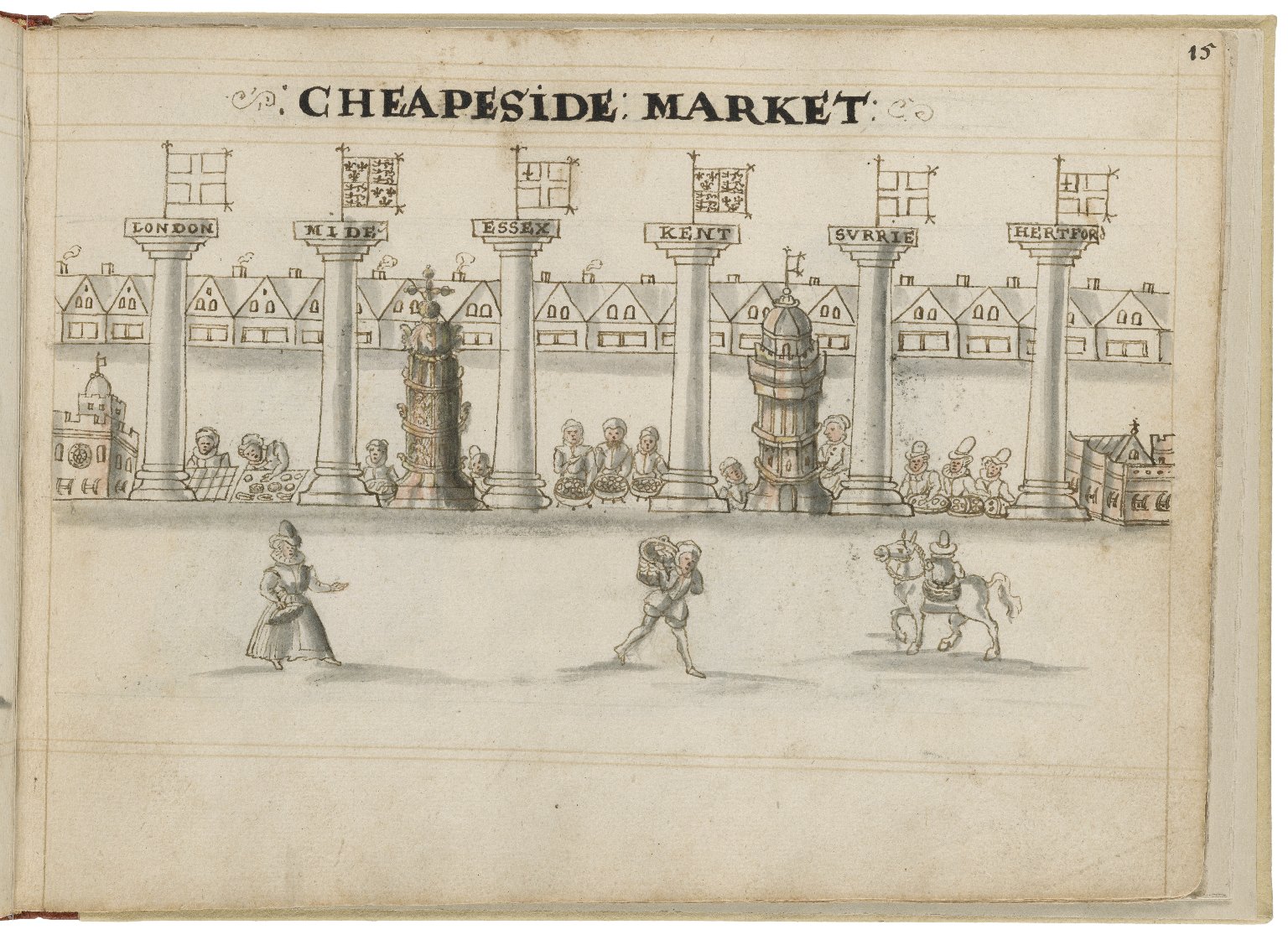
- Cheapside Market
- Cheapside’s Triumphs and Chyron’s Cross’ Lamentation
- Cordwainer Street Ward
- Cripplegate
- Cripplegate Ward
- Excerpt from London Survey’d
- Excerpt from
The Doleful Lamentation of Cheapside Cross
- Excerpts from Bartholomew Fair
- Excerpts from Eastward Ho!
- Excerpts from Epicœne, or the Silent Woman
- Excerpts from If You Know Not Me You Know Nobody, Part 2
- Excerpts from Sir Thomas More
- Excerpts from The Devil Is an Ass
- Excerpts from Westward Ho!
- Executions
- Farringdon Within Ward
- Friday Street
- Garlick Hill
- Goldsmiths’ Row
- Great Conduit (Cheapside)
- Gutter Lane
- Historical Personography
- History of MoEML
- Hosier Lane (Smithfield)
- Huggin Lane (Wood Street)
- Introducing the First Digital Gazetteer of Early Modern London!
- Introduction to The Queen’s Majesty’s Passage
- Introduction to The Triumphs of Truth
- Ironmonger Lane
- Knightrider Street
- Leadenhall Street
- Little Conduit (Cheapside)
- London’s Jus Honorarium
- London’s Tempe
- Lord Mayor’s Shows
- Mercers’ Chapel
- Mercers’ Hall
- Milk Street
- Moorfields
- New Exchange
- Old Cross (Cheapside)
- Petition of the Water Bearers
- Pudding Lane
- Research Streets, Sites, and Playhouses of Early Modern London
- Revels Office
- Soper Lane
- St. Laurence Lane (Guildhall)
- St. Martin’s Lane (le Grand)
- St. Matthew’s Alley
- St. Paul’s Cathedral
- St. Paul’s Churchyard
- St. Paul’s Cross
- St. Paul’s Gate (northern)
- Survey of London (1598): Breadstreet Ward
- Survey of London (1598): Cheap Ward
- Survey of London (1598): Cripplegate Ward
- Survey of London (1598): Farringdon Ward Within
- Survey of London (1598): Gates of this City
- Survey of London (1598): Hospitals
- Survey of London (1598): Lime Street Ward
- Survey of London (1598): Orders and Customs
- Survey of London (1598): Temporal Government
- Survey of London (1598): The City Divided into Parts
- Survey of London (1633): Breadstreet Ward
- Survey of London (1633): Cheap Ward
- Survey of London (1633): Cordwainer Street Ward
- Survey of London (1633): Cripplegate Ward
- Survey of London (1633): Farringdon Ward Within
- Survey of London (1633): Gates of this City
- Survey of London (1633): Lime Street Ward
- Survey of London (1633): Orders and Customs
- Survey of London (1633): Suburbs Without the Walls
- Survey of London (1633): Temporal Government
- Teaching with MoEML: Three Parts of King Henry IV
- The Carriers’ Cosmography
- The Great Snow
- The Key (Cheapside)
- The Magnificent Entertainment
- The Queen’s Majesty’s Passage
- The Sounds of Pageantry
- The Standard (Cheapside)
- The Triumphs of Honor and Industry
- The Triumphs of Truth
- Three Cups Inn (Bread Street)
- Tower Street
- Troia-Nova Triumphans, or London Triumphing
- Tudor Royal Progresses
- Variant spellings
- Wood Street
List variant names and spellingsCheap | Cheap-side | Cheap-ſide | Cheape | Cheape side | Cheape street | Cheape streete | Cheape warde | Cheape ſtreet | Cheape-ſide | Cheapeside | Cheapside | Cheapside Street | Cheapſide | Chepe | Chepe-ſide | Chepeside | Chepesyde | Cheppes syed | West Cheape | West Cheaping | Westcheap | Weſt Cheape | Weſt-Cheape | cheape | cheapside | high street of Cheape | high streete of Cheape | high ſtreet of Cheape | weſt Cheape
Cheapside Street, one of the most important streets in early modern London, ran east-west between the Great Conduit at the foot of Old Jewry to the Little Conduit by St. Paul’s churchyard. The terminus of all the northbound streets from the river, the broad expanse of
Cheapside Street separated the northern wards from the southern wards. It was lined with buildings
three, four, and even five stories tall, whose shopfronts were open to the light and
set out with attractive displays of luxury commodities (Weinreb and Hibbert 148). Cheapside Street was the centre of London’s wealth, with many mercers’ and goldsmiths’ shops located there. It was also the most sacred stretch of the processional route,
being traced both by the linear east-west route of a royal entry and by the circular
route of the annual mayoral procession.
Both the street and Cheap Ward through which it ran were named for the market located there. Cheapside Street or West Cheap was the site of a great medieval food market. West Cheap and East Cheap were the two principal market areas of London, both created during King Alfred’s program of urban renewal in the ninth century (Sheppard 71). Over time, Cheapside became the more prestigious market location. The name originated from the word
chepe,which has also been spelled
cepeand
cheop,and which means a market, or bargaining place (OED cheap, n.2.).
The importance of Cheapside Street increased greatly after 1087. It was in this year that Mauritius, then the bishop of London, began rebuilding St. Paul’s cathedral (Stow 1:324). The new church’s footprint was much larger than that of the previous structure,
and it blocked traffic running from Aldgate to Ludgate. To alleviate the congestion and danger caused by frequently turning horses and wagons,
Newgate was built, allowing traffic to flow through the city on Cheapside Street. Thus the street grew very busy and became a good location for tradespeople to sell
their wares (Stow 1:35–36). The names of the streets leading out of Cheapside Street are a good indication of some of the goods sold there: Bread Street, Wood Street, honey, Milk Street, and Poultry (Bebbington 82). More evidence of the high traffic in Cheapside Street is found in a royal proclamation by Edward I, designed to ease congestion:
All manner of victuals that are sold by persons in Chepe, upon Cornhulle, and elsewhere in the City, such as bread, cheese, poultry, fruit, hides and skins, onions and garlic, and all other small victuals, for sale as well by denizens as by strangers, shall stand midway between the kennels [gutters] of the streets, so as to be a nuisance to no one under pain of forfeiture of the article. (Bebbington 82)
By Stow’s time, Cheapside Street had many important landmarks as well. On the east end of the street was the Great Conduit, where people could get fresh water, conveyed by underground pipes from Paddington.
At the west end were a little conduit near Paul’s gate, St. Paul’s itself, and the Standard in Cheapside. Executions of criminals were once performed at the Standard (Stow 1:265). The Saddlers’ Hall, and several churches, including St. Mary-le-Bow, St Peter, Westcheap, and St. Michael at Corn, were also located on Cheapside Street. In the street itself jousts and various other entertainments were often held (Bebbington 82).
Also on Cheapside Street was Cheapside Cross, three stories tall, erected by decree of Edward I after the death of his wife Eleanor (Weinreb and Hibbert 148). She died in the countryside, near Lincoln, and at every place her body rested on
the way to Westminster, Edward ordered a great stone cross to be built with her image upon it. Cheapisde Cross fell into ruin over many years and was recommissioned and repaired several times,
often with funds from local mercers. It was newly gilt for the coronation procession
of each new monarch, and for the entry processions of visiting monarchs until 1581, when it was defaced by vandals (Stow 1:266–267).
The most sacred segment of the coronation processional route was along Cheapside Street. It was here that the most expensive and elaborate pageants took place, as can be
seen in Thomas Dekker’s The Magnificent Entertainment (1604)1 and Richard Mulcaster’s The Quenes Maiesties Passage.2 The most extravagant portions of the Lord Mayor’s pageant also took place here, such as those in Thomas Middleton’s The Triumphs of Truth.
The part of Cheapside known as
Goldsmiths’ Rowran between Bread Street and Friday Street (Weinreb and Hibbert 148). Goldsmiths’ Row and the shops and homes of other wealthy merchants made the street an elite and attractive one. Stow claims that there were ten houses and fourteen shops in Goldsmith’s Row, and that they were easily the most beautiful in London (Stow 1:296, 1:345–346). The Mercers’ Hall was also located on the North side of Cheapside Street. The result was a high concentration of wealth and power in Cheapside Street.3
Eventually, goldsmiths began to leave Goldsmiths’ Row, and other businesses moved in. James I wanted to keep all the goldsmiths in one place because it made for a more beautiful street, with fine houses kept by
rich men, and because it was easier for him to monitor trade in gold. The king passed
laws requiring non-goldsmiths to leave and goldsmiths elsewhere in the city to relocate to Cheapside Street. By 1628 the Privy Council was imprisoning non-goldsmiths who refused to vacate.
The infrastructure on Cheapside Street was destroyed in the Great Fire of 1666, as was the rest of Cheap Ward. St. Mary-le-Bow and the Mercers’ and Saddlers’ Halls were rebuilt (Weinreb and Hibbert 148).4
Notes
- See The Magnificent Entertainment in our Library. (KL)↑
- See The Queen’s Majesty’s Passage in our Library. (KL)↑
- Cheapside is once again
becoming one of the City of London’s most prestigious shopping destinations,
according to the Cheapside Initiative project. (KL)↑ - For more information on Cheapside Street, see Griffiths, Harding, Jenstad, Reddaway, and Chalfant 53. (KL)↑
References
-
Citation
Bebbington, Gillian. London Street Names. London: B.T. Batsford, 1972. Print.This item is cited in the following documents:
-
Citation
Chalfant, Fran C. Ben Jonson’s London: A Jacobean Placename Dictionary. Athens: U of Georgia P, 1978. Print.This item is cited in the following documents:
-
Citation
Griffiths, Paul.Politics Made Visible: Order, Residence, and Uniformity in Cheapside, 1600–45.
Londinopolis: Essays in the Cultural and Social History of Early Modern London. Ed. Paul Griffiths and Mark S.R. Jenner. Manchester: Manchester UP, 2000. 176–196. Print.This item is cited in the following documents:
-
Citation
Harding, Vanessa.Cheapside: Commerce and Commemoration.
Huntington Library Quarterly 71.1 (2008): 77–98.This item is cited in the following documents:
-
Citation
Jenstad, Janelle.
Early Modern Literary Studies 8.2 (2002): 5.1–26..The City Cannot Hold You
: Social Conversion in the Goldsmith’s Shop.This item is cited in the following documents:
-
Citation
Oxford English Dictionary. Oxford UP. https://www.oed.com/.This item is cited in the following documents:
-
Citation
Reddaway, T.F.Elizabethan London—Goldsmiths’ Row in Cheapside, 1558–1645.
Guildhall Miscellany 2 (1963): 181–206.This item is cited in the following documents:
-
Citation
Sheppard, Francis. London: A History. Oxford: Oxford UP, 1998. Print.This item is cited in the following documents:
-
Citation
Stow, John. A Survey of London. Reprinted from the Text of 1603. Ed. Charles Lethbridge Kingsford. 2 vols. Oxford: Clarendon, 1908. See also the digital transcription of this edition at British History Online.This item is cited in the following documents:
-
Citation
Weinreb, Ben, and Christopher Hibbert, eds. The London Encyclopaedia. New York: St. Martin’s P, 1983. Print. [You may also wish to consult the 3rd edition, published in 2008.]This item is cited in the following documents:
Cite this page
MLA citation
, and .
Cheapside Street.The Map of Early Modern London, Edition 7.0, edited by , U of Victoria, 05 May 2022, mapoflondon.uvic.ca/edition/7.0/CHEA2.htm.
Chicago citation
, and .
Cheapside Street.The Map of Early Modern London, Edition 7.0. Ed. . Victoria: University of Victoria. Accessed May 05, 2022. mapoflondon.uvic.ca/edition/7.0/CHEA2.htm.
APA citation
, & 2022. Cheapside Street. In (Ed), The Map of Early Modern London (Edition 7.0). Victoria: University of Victoria. Retrieved from https://mapoflondon.uvic.ca/editions/7.0/CHEA2.htm.
RIS file (for RefMan, RefWorks, EndNote etc.)
Provider: University of Victoria
Database: The Map of Early Modern London
Content: text/plain; charset="utf-8"

TY  - ELEC
A1  - Campbell, James
A1  - Jenstad, Janelle
ED  - Jenstad, Janelle
T1  - Cheapside Street
T2  - The Map of Early Modern London
ET  - 7.0
PY  - 2022
DA  - 2022/05/05
CY  - Victoria
PB  - University of Victoria
LA  - English
UR  - https://mapoflondon.uvic.ca/edition/7.0/CHEA2.htm
UR  - https://mapoflondon.uvic.ca/edition/7.0/xml/standalone/CHEA2.xml
ER  -
TEI citation
<bibl type="mla"><author><name ref="#CAMP1"><surname>Campbell</surname>, <forename>James</forename></name></author>,
and <author><name ref="#JENS1"><forename>Janelle</forename> <surname>Jenstad</surname></name></author>.
<title level="a">Cheapside Street</title>. <title level="m">The Map of Early Modern
London</title>, Edition <edition>7.0</edition>, edited by <editor><name ref="#JENS1"><forename>Janelle</forename>
<surname>Jenstad</surname></name></editor>, <publisher>U of Victoria</publisher>,
<date when="2022-05-05">05 May 2022</date>, <ref target="https://mapoflondon.uvic.ca/edition/7.0/CHEA2.htm">mapoflondon.uvic.ca/edition/7.0/CHEA2.htm</ref>.</bibl>
Personography
-
Jamie Zabel
JZ
Research Assistant, 2020-2021. Managing Encoder, 2020-2021. Jamie Zabel was an MA student at the University of Victoria in the Department of English. She completed her BA in English at the University of British Columbia in 2017. She published a paper in University College London’s graduate publication Moveable Type (2020) and presented at the University of Victoria’s 2021 Digital Humanities Summer Institute. During her time at MoEML, she made significant contributions to the 1598 and 1633 editions of Stow’s Survey as proofreader, editor, and encoder, coordinated the encoding of the 1633 edition, and researched and authored a number of encyclopedia articles and geo-coordinates to supplement both editions. She also played a key role in managing the correction process of MoEML’s Gazetteer.Roles played in the project
-
Abstract Author
-
Author
-
CSS Editor
-
Copy Editor
-
Data Manager
-
Editor
-
Encoder
-
Geo-Coordinate Researcher
-
Markup Editor
-
Primary Encoder
-
Proofreader
-
Researcher
-
Transcription Proofreader
Contributions by this author
Jamie Zabel is a member of the following organizations and/or groups:
Jamie Zabel is mentioned in the following documents:
-
-
Kate LeBere
KL
Project Manager, 2020-2021. Assistant Project Manager, 2019-2020. Research Assistant, 2018-2020. Kate LeBere completed her BA (Hons.) in History and English at the University of Victoria in 2020. She published papers in The Corvette (2018), The Albatross (2019), and PLVS VLTRA (2020) and presented at the English Undergraduate Conference (2019), Qualicum History Conference (2020), and the Digital Humanities Summer Institute’s Project Management in the Humanities Conference (2021). While her primary research focus was sixteenth and seventeenth century England, she completed her honours thesis on Soviet ballet during the Russian Cultural Revolution. During her time at MoEML, Kate made significant contributions to the 1598 and 1633 editions of Stow’s Survey of London, old-spelling anthology of mayoral shows, and old-spelling library texts. She authored the MoEML’s first Project Management Manual andquickstart
guidelines for new employees and helped standardize the Personography and Bibliography. She is currently a student at the University of British Columbia’s iSchool, working on her masters in library and information science.Roles played in the project
-
Abstract Author
-
Author
-
CSS Editor
-
Compiler
-
Conceptor
-
Copy Editor
-
Data Manager
-
Editor
-
Encoder
-
Geo-Coordinate Researcher
-
Markup Editor
-
Proofreader
-
Researcher
-
Toponymist
-
Transcriber
-
Transcription Proofreader
Contributions by this author
Kate LeBere is a member of the following organizations and/or groups:
Kate LeBere is mentioned in the following documents:
-
-
Joey Takeda
JT
Programmer, 2018-present. Junior Programmer, 2015-2017. Research Assistant, 2014-2017. Joey Takeda was a graduate student at the University of British Columbia in the Department of English (Science and Technology research stream). He completed his BA honours in English (with a minor in Women’s Studies) at the University of Victoria in 2016. His primary research interests included diasporic and indigenous Canadian and American literature, critical theory, cultural studies, and the digital humanities.Roles played in the project
-
Abstract Author
-
Author
-
CSS Editor
-
Compiler
-
Conceptor
-
Copy Editor
-
Editor
-
Encoder
-
Geo-Coordinate Researcher
-
Junior Programmer
-
Markup Editor
-
Post-Conversion Editor
-
Programmer
-
Proofreader
-
Researcher
-
Toponymist
-
Transcriber
-
Transcription Proofreader
Contributions by this author
Joey Takeda is a member of the following organizations and/or groups:
Joey Takeda is mentioned in the following documents:
Joey Takeda authored or edited the following items in MoEML’s bibliography:
-
Jenstad, Janelle and Joseph Takeda.
Making the RA Matter: Pedagogy, Interface, and Practices.
Making Things and Drawing Boundaries: Experiments in the Digital Humanities. Ed. Jentery Sayers. Minnesota: University of Minnesota Press, 2018. Print.
-
-
Tye Landels-Gruenewald
TLG
Data Manager, 2015-2016. Research Assistant, 2013-2015. Tye completed his undergraduate honours degree in English at the University of Victoria in 2015.Roles played in the project
-
Author
-
CSS Editor
-
Compiler
-
Conceptor
-
Copy Editor
-
Data Manager
-
Editor
-
Encoder
-
Geo-Coordinate Researcher
-
Markup Editor
-
Metadata Architect
-
Proofreader
-
Researcher
-
Toponymist
-
Transcriber
-
Transcription Proofreader
Contributions by this author
Tye Landels-Gruenewald is a member of the following organizations and/or groups:
Tye Landels-Gruenewald is mentioned in the following documents:
-
-
James Campbell
JDC
Research Assistant, 2002–2003. Student contributor enrolled in English 412: Representations of London at the University of Windsor in Fall 2002. BA honours student, English Language and Literature, University of Windsor.Roles played in the project
-
Author
-
Transcriber
Contributions by this author
James Campbell is a member of the following organizations and/or groups:
James Campbell is mentioned in the following documents:
-
-
Melanie Chernyk
MJC
Research Assistant, 2004–2008. BA honours, 2006. MA English, University of Victoria, 2007. Melanie Chernyk went on to work at the Electronic Textual Cultures Lab at the University of Victoria and now manages Talisman Books and Gallery on Pender Island, BC. She also has her own editing business at http://26letters.ca.Roles played in the project
-
Author
-
Compiler
-
Copy Editor
-
Encoder
-
Researcher
-
Toponymist
-
Transcriber
Contributions by this author
Melanie Chernyk is a member of the following organizations and/or groups:
Melanie Chernyk is mentioned in the following documents:
-
-
Kim McLean-Fiander
KMF
Director of Pedagogy and Outreach, 2015–2020. Associate Project Director, 2015. Assistant Project Director, 2013-2014. MoEML Research Fellow, 2013. Kim McLean-Fiander comes to The Map of Early Modern London from the Cultures of Knowledge digital humanities project at the University of Oxford, where she was the editor of Early Modern Letters Online, an open-access union catalogue and editorial interface for correspondence from the sixteenth to eighteenth centuries. She is currently Co-Director of a sister project to EMLO called Women’s Early Modern Letters Online (WEMLO). In the past, she held an internship with the curator of manuscripts at the Folger Shakespeare Library, completed a doctorate at Oxford on paratext and early modern women writers, and worked a number of years for the Bodleian Libraries and as a freelance editor. She has a passion for rare books and manuscripts as social and material artifacts, and is interested in the development of digital resources that will improve access to these materials while ensuring their ongoing preservation and conservation. An avid traveler, Kim has always loved both London and maps, and so is particularly delighted to be able to bring her early modern scholarly expertise to bear on the MoEML project.Roles played in the project
-
Associate Project Director
-
Author
-
CSS Editor
-
Compiler
-
Conceptor
-
Copy Editor
-
Data Manager
-
Director of Pedagogy and Outreach
-
Editor
-
Encoder
-
Geo-Coordinate Researcher
-
Managing Editor
-
Markup Editor
-
Metadata Architect
-
Research Fellow
-
Toponymist
-
Transcriber
-
Transcription Proofreader
-
Vetter
Contributions by this author
Kim McLean-Fiander is a member of the following organizations and/or groups:
Kim McLean-Fiander is mentioned in the following documents:
-
-
Janelle Jenstad
JJ
Janelle Jenstad is Associate Professor of English at the University of Victoria, Director of The Map of Early Modern London, and PI of Linked Early Modern Drama Online. She has taught at Queen’s University, the Summer Academy at the Stratford Festival, the University of Windsor, and the University of Victoria. With Jennifer Roberts-Smith and Mark Kaethler, she co-edited Shakespeare’s Language in Digital Media (Routledge). She has prepared a documentary edition of John Stow’s A Survey of London (1598 text) for MoEML and is currently editing The Merchant of Venice (with Stephen Wittek) and Heywood’s 2 If You Know Not Me You Know Nobody for DRE. Her articles have appeared in Digital Humanities Quarterly, Renaissance and Reformation,Journal of Medieval and Early Modern Studies, Early Modern Literary Studies, Elizabethan Theatre, Shakespeare Bulletin: A Journal of Performance Criticism, and The Silver Society Journal. Her book chapters have appeared (or will appear) in Institutional Culture in Early Modern Society (Brill, 2004), Shakespeare, Language and the Stage, The Fifth Wall: Approaches to Shakespeare from Criticism, Performance and Theatre Studies (Arden/Thomson Learning, 2005), Approaches to Teaching Othello (Modern Language Association, 2005), Performing Maternity in Early Modern England (Ashgate, 2007), New Directions in the Geohumanities: Art, Text, and History at the Edge of Place (Routledge, 2011), Early Modern Studies and the Digital Turn (Iter, 2016), Teaching Early Modern English Literature from the Archives (MLA, 2015), Placing Names: Enriching and Integrating Gazetteers (Indiana, 2016), Making Things and Drawing Boundaries (Minnesota, 2017), and Rethinking Shakespeare’s Source Study: Audiences, Authors, and Digital Technologies (Routledge, 2018).Roles played in the project
-
Abstract Author
-
Author
-
Author (Preface)
-
Author of Preface
-
Compiler
-
Conceptor
-
Copy Editor
-
Course Instructor
-
Course Supervisor
-
Data Manager
-
Editor
-
Encoder
-
Geo-Coordinate Researcher
-
Markup Editor
-
Peer Reviewer
-
Project Director
-
Proofreader
-
Researcher
-
Toponymist
-
Transcriber
-
Transcription Proofreader
-
Vetter
Contributions by this author
Janelle Jenstad is a member of the following organizations and/or groups:
Janelle Jenstad is mentioned in the following documents:
Janelle Jenstad authored or edited the following items in MoEML’s bibliography:
-
Jenstad, Janelle and Joseph Takeda.
Making the RA Matter: Pedagogy, Interface, and Practices.
Making Things and Drawing Boundaries: Experiments in the Digital Humanities. Ed. Jentery Sayers. Minnesota: University of Minnesota Press, 2018. Print. -
Jenstad, Janelle.
Building a Gazetteer for Early Modern London, 1550-1650.
Placing Names. Ed. Merrick Lex Berman, Ruth Mostern, and Humphrey Southall. Bloomington and Indianapolis: Indiana UP, 2016. 129-145. -
Jenstad, Janelle.
The Burse and the Merchant’s Purse: Coin, Credit, and the Nation in Heywood’s 2 If You Know Not Me You Know Nobody.
The Elizabethan Theatre XV. Ed. C.E. McGee and A.L. Magnusson. Toronto: P.D. Meany, 2002. 181–202. Print. -
Jenstad, Janelle.
Early Modern Literary Studies 8.2 (2002): 5.1–26..The City Cannot Hold You
: Social Conversion in the Goldsmith’s Shop. -
Jenstad, Janelle.
The Silver Society Journal 10 (1998): 40–43.The Gouldesmythes Storehowse
: Early Evidence for Specialisation. -
Jenstad, Janelle.
Lying-in Like a Countess: The Lisle Letters, the Cecil Family, and A Chaste Maid in Cheapside.
Journal of Medieval and Early Modern Studies 34 (2004): 373–403. doi:10.1215/10829636–34–2–373. -
Jenstad, Janelle.
Public Glory, Private Gilt: The Goldsmiths’ Company and the Spectacle of Punishment.
Institutional Culture in Early Modern Society. Ed. Anne Goldgar and Robert Frost. Leiden: Brill, 2004. 191–217. Print. -
Jenstad, Janelle.
Smock Secrets: Birth and Women’s Mysteries on the Early Modern Stage.
Performing Maternity in Early Modern England. Ed. Katherine Moncrief and Kathryn McPherson. Aldershot: Ashgate, 2007. 87–99. Print. -
Jenstad, Janelle.
Using Early Modern Maps in Literary Studies: Views and Caveats from London.
GeoHumanities: Art, History, Text at the Edge of Place. Ed. Michael Dear, James Ketchum, Sarah Luria, and Doug Richardson. London: Routledge, 2011. Print. -
Jenstad, Janelle.
Versioning John Stow’s A Survey of London, or, What’s New in 1618 and 1633?.
Janelle Jenstad Blog. https://janellejenstad.com/2013/03/20/versioning-john-stows-a-survey-of-london-or-whats-new-in-1618-and-1633/. -
Shakespeare, William. The Merchant of Venice. Ed. Janelle Jenstad. Internet Shakespeare Editions. U of Victoria. http://internetshakespeare.uvic.ca/Library/Texts/MV/.
-
Stow, John. A SVRVAY OF LONDON. Contayning the Originall, Antiquity, Increase, Moderne estate, and description of that Citie, written in the yeare 1598. by Iohn Stow Citizen of London. Also an Apologie (or defence) against the opinion of some men, concerning that Citie, the greatnesse thereof. With an Appendix, containing in Latine, Libellum de situ & nobilitate Londini: written by William Fitzstephen, in the raigne of Henry the second. Ed. Janelle Jenstad and the MoEML Team. MoEML. Transcribed.
-
-
Stewart Arneil
Programmer at the University of Victoria Humanities Computing and Media Centre (HCMC) who maintained the Map of London project between 2006 and 2011. Stewart was a co-applicant on the SSHRC Insight Grant for 2012–16.Roles played in the project
-
Programmer
Stewart Arneil is a member of the following organizations and/or groups:
Stewart Arneil is mentioned in the following documents:
-
-
Martin D. Holmes
MDH
Programmer at the University of Victoria Humanities Computing and Media Centre (HCMC). Martin ported the MOL project from its original PHP incarnation to a pure eXist database implementation in the fall of 2011. Since then, he has been lead programmer on the project and has also been responsible for maintaining the project schemas. He was a co-applicant on MoEML’s 2012 SSHRC Insight Grant.Roles played in the project
-
Abstract Author
-
Author
-
Conceptor
-
Editor
-
Encoder
-
Geo-Coordinate Researcher
-
Markup Editor
-
Post-Conversion Editor
-
Programmer
-
Proofreader
-
Researcher
Contributions by this author
Martin D. Holmes is a member of the following organizations and/or groups:
Martin D. Holmes is mentioned in the following documents:
-
-
Alfred the Great
Alfred the Great King of Wessex King of the Anglo-Saxons
(b. between 848 and 849, d. 899)King of Wessex 871-886. King of the Anglo-Saxons 886-899. Father of Ethelfled. Father-in-law of Æthelred and Adhered.Alfred the Great is mentioned in the following documents:
-
Hugh Alley
Author.Hugh Alley is mentioned in the following documents:
Hugh Alley authored or edited the following items in MoEML’s bibliography:
-
Alley, Hugh. Hugh Alley’s Caveat: The Markets of London in 1598: Folger MS V.a. 318. Ed. Ian Archer, Caroline Barron, and Vanessa Harding. London: London Topographical Society, 1988. Print.
-
Thomas Dekker is mentioned in the following documents:
Thomas Dekker authored or edited the following items in MoEML’s bibliography:
-
Bevington, David. Introduction.
The Shoemaker’s Holiday.
By Thomas Dekker. English Renaissance Drama: A Norton Anthology. Ed. David Bevington, Lars Engle, Katharine Eisaman Maus, and Eric Rasmussen. New York: Norton, 2002. 483–487. Print. -
Dekker, Thomas, and John Webster. Vvest-vvard hoe As it hath been diuers times acted by the Children of Paules. London: [William Jaggard] for Iohn Hodgets, 1607. STC 6540.
-
Dekker, Thomas. Britannia’s Honor.
The Dramatic Works of Thomas Dekker.
Vol. 4. Ed. Fredson Bowers. Cambridge: Cambridge UP, 1961. Print. -
Dekker, Thomas. The Dead Tearme. Or Westminsters Complaint for long Vacations and short Termes. Written in Manner of a Dialogue betweene the two Cityes London and Westminster. 1608. The Non-Dramatic Works of Thomas Dekker. Ed. Rev. Alexander B. Grosart. 5 vols. 1885. Reprinted by New York: Russell and Russell, 1963. 1–84. Print.
-
Dekker, Thomas. The Gull’s Horn-Book: Or, Fashions to Please All Sorts of Gulls. Thomas Dekker: The Wonderful Year, The Gull’s Horn-Book, Penny-Wise, Pound-Foolish, English Villainies Discovered by Lantern and Candelight, and Selected Writings. Ed. E.D. Pendry. London: Edward Arnold, 1967. 64–109. The Stratford-upon-Avon Library 4.
-
Dekker, Thomas. If it be not good, the Diuel is in it A nevv play, as it hath bin lately acted, vvith great applause, by the Queenes Maiesties Seruants: at the Red Bull. London: Printed by Thomas Creede for John Trundle, 1612. STC 6507.
-
Dekker, Thomas. Lantern and Candlelight. 1608. Ed. Viviana Comensoli. Toronto: Centre for Reformation and Renaissance Studies, 2007. Publications of the Barnabe Riche Society.
-
Dekker, Thomas. Londons Tempe, or The Feild of Happines. London: Nicholas Okes, 1629. STC 6509. DEEP 736. Greg 421a. Copy: British Library; Shelfmark: C.34.g.11.
-
Dekker, Thomas. Londons Tempe, or The Feild of Happines. London: Nicholas Okes, 1629. STC 6509. DEEP 736. Greg 421a. Copy: Huntington Library; Shelfmark: Rare Books 59055.
-
Dekker, Thomas. Londons Tempe, or The Feild of Happines. London: Nicholas Okes, 1629. STC 6509. DEEP 736. Greg 421a. Copy: National Library of Scotland; Shelfmark: Bute.143.
-
Dekker, Thomas. London’s Tempe. The Dramatic Works of Thomas Dekker. Ed. Fredson Bowers. Vol. 4. Cambridge: Cambridge UP, 1961. Print.
-
Dekker, Thomas. The magnificent entertainment giuen to King Iames, Queene Anne his wife, and Henry Frederick the Prince, vpon the day of his Maiesties tryumphant passage (from the Tower) through his honourable citie (and chamber) of London, being the 15. of March. 1603. As well by the English as by the strangers: vvith the speeches and songes, deliuered in the seuerall pageants. London: T[homas] C[reede, Humphrey Lownes, Edward Allde and others] for Tho. Man the yonger, 1604. STC 6510
-
Dekker, Thomas. The Magnificent Entertainment: Giuen to King James, Queene Anne his wife, and Henry Frederick the Prince, ypon the day of his Majesties Triumphant Passage (from the Tower) through his Honourable Citie (and Chamber) of London being the 15. Of March. 1603. London: T. Man, 1604. Treasures in full: Renaissance Festival Books. British Library.
-
Dekker, Thomas. The owles almanacke Prognosticating many strange accidents which shall happen to this kingdome of Great Britaine this yeare, 1618. Calculated as well for the meridian mirth of London as any other part of Great Britaine. Found in an iuy-bush written in old characters, and now published in English by the painefull labours of Mr. Iocundary Merrie-braines. London: E[dward] G[riffin] for Laurence Lisle, 1618. STC 6515.
-
Dekker, Thomas. Penny-vvis[e] pound foolish or, a Bristovv diamond, set in t[wo] rings, and both crack’d Profitable for married men, pleasant for young men, a[nd a] rare example for all good women. London: A[ugustine] M[athewes] for Edward Blackmore, 1631. STC 6516.
-
Dekker, Thomas. The Second Part of the Honest Whore, with the Humors of the Patient Man, the Impatient Wife: the Honest Whore, perswaded by strong Arguments to turne Curtizan againe: her braue refuting those Arguments. London: Printed by Elizabeth All-de for Nathaniel Butter, 1630. STC 6506.
-
Dekker, Thomas. The seuen deadly sinnes of London drawne in seuen seuerall coaches, through the seuen seuerall gates of the citie bringing the plague with them. Opus septem dierum. London: E[dward] A[llde and S. Stafford] for Nathaniel Butter, 1606. STC 6522.
-
Dekker, Thomas. The Shoemaker’s Holiday. Ed. R.L. Smallwood and Stanley Wells. Manchester: Manchester UP, 1979. The Revels Plays.
-
Dekker, Thomas. The shomakers holiday. Or The gentle craft VVith the humorous life of Simon Eyre, shoomaker, and Lord Maior of London. As it was acted before the Queenes most excellent Maiestie on New-yeares day at night last, by the right honourable the Earle of Notingham, Lord high Admirall of England, his seruants. London: Valentine Sims, 1600. STC 6523.
-
Dekker, Thomas, Stephen Harrison, Ben Jonson, and Thomas Middleton. The Whole Royal and Magnificent Entertainment of King James through the City of London, 15 March 1604, with the Arches of Triumph. Ed. R. Malcolm Smuts. Thomas Middleton: The Collected Works. Gen. ed. Gary Taylor and John Lavagnino. Oxford: Oxford UP, 2007. 219–279. Print.
-
Dekker, Thomas. Troia-Noua Triumphans. London: Nicholas Okes, 1612. STC 6530. DEEP 578. Greg 302a. Copy: Chapin Library; Shelfmark: 01WIL_ALMA.
-
Dekker, Thomas. TThe shoomakers holy-day. Or The gentle craft VVith the humorous life of Simon Eyre, shoomaker, and Lord Mayor of London. As it was acted before the Queenes most excellent Maiestie on New-yeares day at night last, by the right honourable the Earle of Notingham, Lord high Admirall of England, his seruants. London: G. Eld for I. Wright, 1610. STC 6524.
-
Dekker, Thomas. Westward Ho! The Dramatic Works of Thomas Dekker. Vol. 2. Ed. Fredson Bowers. Cambridge: Cambridge UP, 1964. Print.
-
Middleton, Thomas, and Thomas Dekker. The Roaring Girl. Ed. Paul A. Mulholland. Revels Plays. Manchester: Manchester UP, 1987. Print.
-
Munday, Anthony, Henry Chettle, Thomas Dekker, Thomas Heywood, and William Shakespeare. Sir Thomas More. 1998. Remediated by Project Gutenberg.
-
Munday, Anthony, Henry Chettle, Thomas Dekker, Thomas Heywood, and William Shakespeare. Sir Thomas More. Ed. Vittorio Gabrieli and Giorgio Melchiori. Revels Plays. Manchester; New York: Manchester UP, 1990. Print.
-
Smith, Peter J.
Glossary.
The Shoemakers’ Holiday. By Thomas Dekker. London: Nick Hern, 2004. 108–110. Print.
-
Edward I
Edward This numeral is a Roman numeral. The Arabic equivalent is 1I King of England Longshanks Hammer of the Scots
(b. between 17 June 1239 and 18 June 1239, d. in or before 27 October 1307)Edward I is mentioned in the following documents:
-
Eleanor of Castile
Eleanor Queen consort of England
(b. 1241, d. 1290)Queen of consort England 1272-1290. Wife of Edward I. Heart buried at Blackfriars Monastery. Buried at Westminster Abbey.Eleanor of Castile is mentioned in the following documents:
-
James VI and I
James This numeral is a Roman numeral. The Arabic equivalent is 6VI This numeral is a Roman numeral. The Arabic equivalent is 1I King of Scotland King of England King of Ireland
(b. 1566, d. 1625)James VI and I is mentioned in the following documents:
James VI and I authored or edited the following items in MoEML’s bibliography:
-
James VI and I. Letters of King James VI and I. Ed. G.P.V. Akrigg. Berkeley: U of California P, 1984. Print.
-
Rhodes, Neill, Jennifer Richards, and Joseph Marshall, eds. King James VI and I: Selected Writings. By James VI and I. Aldershot: Ashgate, 2004.
-
Maurice is mentioned in the following documents:
-
Thomas Middleton is mentioned in the following documents:
Thomas Middleton authored or edited the following items in MoEML’s bibliography:
-
Bawcutt, N.W., ed.
Introduction.
The Changeling. By Thomas Middleton and William Rowley. London: Methuen, 1958. Print. -
Brissenden, Alan.
Introduction.
A Chaste Maid in Cheapside. By Thomas Middleton. 2nd ed. New Mermaids. London: A&C Black; New York: Norton, 2002. xi–xxxv. Print. -
Daalder, Joost, ed.
Introduction.
The Changeling. By Thomas Middleton and William Rowley. London: A&C Black, 1990. xii-xiii. Print. -
Dekker, Thomas, Stephen Harrison, Ben Jonson, and Thomas Middleton. The Whole Royal and Magnificent Entertainment of King James through the City of London, 15 March 1604, with the Arches of Triumph. Ed. R. Malcolm Smuts. Thomas Middleton: The Collected Works. Gen. ed. Gary Taylor and John Lavagnino. Oxford: Oxford UP, 2007. 219–279. Print.
-
Holdsworth, R.V., ed.
Introduction.
A Fair Quarrel. By Thomas Middleton and William Rowley. London: Ernest Benn, 1974. xi-xxxix. Print. -
Middleton, Thomas, and Thomas Dekker. The Roaring Girl. Ed. Paul A. Mulholland. Revels Plays. Manchester: Manchester UP, 1987. Print.
-
Middleton, Thomas. A Chaste Maid in Cheapside. Ed. Alan Brissenden. 2nd ed. New Mermaids. London: Benn, 2002.
-
Middleton, Thomas. Civitatis Amor. Ed. David Bergeron. Thomas Middleton: The Collected Works. Gen. ed. Gary Taylor and John Lavagnino. Oxford: Oxford UP, 2007. 1202–8.
-
Middleton, Thomas. The Triumphs of Honour and Industry. London: Printed by Nicholas Okes, 1617. STC 17899.
-
Middleton, Thomas. The Triumphs of Integrity. Ed. David Bergeron. Thomas Middleton: The Collected Works. Gen. ed. Gary Taylor and John Lavagnino. Oxford: Oxford UP, 2007. 1766–1771.
-
Middleton, Thomas. The Triumphs of Love and Antiquity. London: Printed by Nicholas Okes, 1619. STC 17902.
-
Middleton, Thomas. The Triumphs of Truth. London, 1613. Ed. David M. Bergeron. Thomas Middleton: The Collected Works. Ed. Gary Taylor and John Lavagnino. Oxford: Clarendon, 2007. 968–976.
-
Middleton, Thomas. The Triumphs of Truth. London, 1613. STC 17903. [Differs from STC 17904 in that it does not contain the additional entertainment.]
-
Middleton, Thomas. The Triumphs of Truth. London, 1613. STC 17904. [Differs from STC 17903 in that it contains an additional entertainment celebrating Hugh Middleton’s New River project, known as the Entertainment at Amwell Head.]
-
Middleton, Thomas. The Works of Thomas Middleton, now First Collected with Some Account of the Author and notes by The Reverend Alexander Dyce. Ed. Alexander Dyce. London: E. Lumley, 1840. Print.
-
Taylor, Gary, and John Lavagnino, eds. Thomas Middleton: The Collected Works. By Thomas Middleton. Oxford: Oxford UP, 2007. The Oxford Middleton. Print.
-
Richard Mulcaster is mentioned in the following documents:
Richard Mulcaster authored or edited the following items in MoEML’s bibliography:
-
Mulcaster, Richard. The Queen’s Majesty’s Passage. London: Printed by R. Tottill, 1559. SCN 7589.5. Ed. Jennie Butler and Janelle Jenstad. MoEML. Transcribed. Open.
-
John Stow
(b. between 1524 and 1525, d. 1605)Historian and author of A Survey of London. Husband of Elizabeth Stow.John Stow is mentioned in the following documents:
John Stow authored or edited the following items in MoEML’s bibliography:
-
Blome, Richard.
Aldersgate Ward and St. Martins le Grand Liberty Taken from the Last Survey, with Corrections.
A Survey of the Cities of London and Westminster: Containing the Original, Antiquity, Increase, Modern Estate and Government of those Cities. By John Stow and John Strype. Vol. 1. London: A. Churchill, J. Knapton, R. Knaplock, J. Walthoe, E. Horne, B. Tooke, D. Midwinter, B. Cowse, R. Robinson, and T. Ward, 1720. Insert between sig. M3r and sig. M4v. [See more information about this map.] -
Blome, Richard.
Aldgate Ward with its Division into Parishes. Taken from the Last Survey, with Corrections & Additions.
A Survey of the Cities of London and Westminster: Containing the Original, Antiquity, Increase, Modern Estate and Government of those Cities. By John Stow and John Strype. Vol. 1. London: A. Churchill, J. Knapton, R. Knaplock, J. Walthoe, E. Horne, B. Tooke, D. Midwinter, B. Cowse, R. Robinson, and T. Ward, 1720. Insert between sig. H3r and sig. H4v. [See more information about this map.] -
Blome, Richard.
Billingsgate Ward and Bridge Ward Within with it’s Division into Parishes, Taken from the Last Survey.
A Survey of the Cities of London and Westminster: Containing the Original, Antiquity, Increase, Modern Estate and Government of those Cities. By John Stow and John Strype. Vol. 1. London: A. Churchill, J. Knapton, R. Knaplock, J. Walthoe, E. Horne, B. Tooke, D. Midwinter, B. Cowse, R. Robinson, and T. Ward, 1720. Insert between sig. Y2r and sig. Y3v. [See more information about this map.] -
Blome, Richard.
Bishopsgate-street Ward. Taken from the Last Survey and Corrected.
A Survey of the Cities of London and Westminster: Containing the Original, Antiquity, Increase, Modern Estate and Government of those Cities. By John Stow and John Strype. Vol. 1. London: A. Churchill, J. Knapton, R. Knaplock, J. Walthoe, E. Horne, B. Tooke, D. Midwinter, B. Cowse, R. Robinson, and T. Ward, 1720. Insert between sig. N1r and sig. N2v. [See more information about this map.] -
Blome, Richard.
Bread Street Ward and Cardwainter Ward with its Division into Parishes Taken from the Last Survey.
A Survey of the Cities of London and Westminster: Containing the Original, Antiquity, Increase, Modern Estate and Government of those Cities. By John Stow and John Strype. Vol. 1. London: A. Churchill, J. Knapton, R. Knaplock, J. Walthoe, E. Horne, B. Tooke, D. Midwinter, B. Cowse, R. Robinson, and T. Ward, 1720. Insert between sig. B3r and sig. B4v. [See more information about this map.] -
Blome, Richard.
Broad Street Ward with its Division into Parishes, Taken from the Last Survey with Corrections and Additions, & Cornhill Ward with its Divisions into Parishes, Taken from the Last Survey, &c.
A Survey of the Cities of London and Westminster: Containing the Original, Antiquity, Increase, Modern Estate and Government of those Cities. By John Stow and John Strype. Vol. 1. London: A. Churchill, J. Knapton, R. Knaplock, J. Walthoe, E. Horne, B. Tooke, D. Midwinter, B. Cowse, R. Robinson, and T. Ward, 1720. Insert between sig. P2r and sig. P3v. [See more information about this map.] -
Blome, Richard.
Cheape Ward with its Division into Parishes, Taken from the Last Survey, with Corrections and Additions.
A Survey of the Cities of London and Westminster: Containing the Original, Antiquity, Increase, Modern Estate and Government of those Cities. By John Stow and John Strype. Vol. 1. London: A. Churchill, J. Knapton, R. Knaplock, J. Walthoe, E. Horne, B. Tooke, D. Midwinter, B. Cowse, R. Robinson, and T. Ward, 1720. Insert between sig.D1r and sig. D2v. [See more information about this map.] -
Blome, Richard.
Coleman Street Ward and Bashishaw Ward Taken from the Last Survey with Corrections and Additions.
A Survey of the Cities of London and Westminster: Containing the Original, Antiquity, Increase, Modern Estate and Government of those Cities. By John Stow and John Strype. Vol. 1. London: A. Churchill, J. Knapton, R. Knaplock, J. Walthoe, E. Horne, B. Tooke, D. Midwinter, B. Cowse, R. Robinson, and T. Ward, 1720. Insert between sig. G2r and sig. G3v. [See more information about this map.] -
Blome, Richard.
Cow Cross being St Sepulchers Parish Without and the Charterhouse.
A Survey of the Cities of London and Westminster: Containing the Original, Antiquity, Increase, Modern Estate and Government of those Cities. By John Stow and John Strype. Vol. 2. London: A. Churchill, J. Knapton, R. Knaplock, J. Walthoe, E. Horne, B. Tooke, D. Midwinter, B. Cowse, R. Robinson, and T. Ward, 1720. Insert between sig. H2v and sig. H3r. [See more information about this map.] -
Blome, Richard.
Creplegate Ward with its Division into Parishes, Taken from the Last Survey, with Additions, and Corrections.
A Survey of the Cities of London and Westminster: Containing the Original, Antiquity, Increase, Modern Estate and Government of those Cities. By John Stow and John Strype. Vol. 1. London: A. Churchill, J. Knapton, R. Knaplock, J. Walthoe, E. Horne, B. Tooke, D. Midwinter, B. Cowse, R. Robinson, and T. Ward, 1720. Insert between sig. I3r and sig. I4v. [See more information about this map.] -
Blome, Richard.
Farrington Ward Without, with its Division into Parishes, Taken from the Last Survey with Corrections & Amendments.
A Survey of the Cities of London and Westminster: Containing the Original, Antiquity, Increase, Modern Estate and Government of those Cities. By John Stow and John Strype. Vol. 1. London: A. Churchill, J. Knapton, R. Knaplock, J. Walthoe, E. Horne, B. Tooke, D. Midwinter, B. Cowse, R. Robinson, and T. Ward, 1720. Insert between sig. 2F3r and sig. 2F4v. [See more information about this map.] -
Blome, Richard.
Lambeth and Christ Church Parish Southwark. Taken from ye last Survey with Corrections.
A Survey of the Cities of London and Westminster: Containing the Original, Antiquity, Increase, Modern Estate and Government of those Cities. By John Stow and John Strype. Vol. 2. London: A. Churchill, J. Knapton, R. Knaplock, J. Walthoe, E. Horne, B. Tooke, D. Midwinter, B. Cowse, R. Robinson, and T. Ward, 1720. Insert between sig. Z1r and sig. Z2r. [See more information about this map.] -
Blome, Richard.
Langborne Ward with its Division into Parishes. Corrected from the Last Survey. & Candlewick Ward with its Division into Parishes. Corrected from the Last Survey.
A Survey of the Cities of London and Westminster: Containing the Original, Antiquity, Increase, Modern Estate and Government of those Cities. By John Stow and John Strype. Vol. 1. London: A. Churchill, J. Knapton, R. Knaplock, J. Walthoe, E. Horne, B. Tooke, D. Midwinter, B. Cowse, R. Robinson, and T. Ward, 1720. Insert between sig. U3r and sig. U4v. [See more information about this map.] -
Blome, Richard.
A Map of St. Gilles’s Cripple Gate. Without. With Large Additions and Corrections.
A Survey of the Cities of London and Westminster: Containing the Original, Antiquity, Increase, Modern Estate and Government of those Cities. By John Stow and John Strype. Vol. 2. London: A. Churchill, J. Knapton, R. Knaplock, J. Walthoe, E. Horne, B. Tooke, D. Midwinter, B. Cowse, R. Robinson, and T. Ward, 1720. Insert between sig. H2v and sig. H3r. [See more information about this map.] -
Blome, Richard.
A Map of the Parish of St. Dunstans Stepney, als. Stebunheath Divided into Hamlets.
A Survey of the Cities of London and Westminster: Containing the Original, Antiquity, Increase, Modern Estate and Government of those Cities. By John Stow and John Strype. Vol. 2. London: A. Churchill, J. Knapton, R. Knaplock, J. Walthoe, E. Horne, B. Tooke, D. Midwinter, B. Cowse, R. Robinson, and T. Ward, 1720. Insert between sig. F3r and sig. F4v. [See more information about this map.] -
Blome, Richard.
A Map of the Parish of St Mary White Chappel and a Map of the Parish of St Katherines by the Tower.
A Survey of the Cities of London and Westminster: Containing the Original, Antiquity, Increase, Modern Estate and Government of those Cities. By John Stow and John Strype. Vol. 2. London: A. Churchill, J. Knapton, R. Knaplock, J. Walthoe, E. Horne, B. Tooke, D. Midwinter, B. Cowse, R. Robinson, and T. Ward, 1720. Insert between sig. F2r and sig. F3v. [See more information about this map.] -
Blome, Richard.
A Mapp of Lime Street Ward. Taken from ye Last Surveys & Corrected.
A Survey of the Cities of London and Westminster: Containing the Original, Antiquity, Increase, Modern Estate and Government of those Cities. By John Stow and John Strype. Vol. 1. London: A. Churchill, J. Knapton, R. Knaplock, J. Walthoe, E. Horne, B. Tooke, D. Midwinter, B. Cowse, R. Robinson, and T. Ward, 1720. Insert between sig. M1r and sig. M2v. [See more information about this map.] -
Blome, Richard.
A Mapp of St. Andrews Holborn Parish as well Within the Liberty as Without.
A Survey of the Cities of London and Westminster: Containing the Original, Antiquity, Increase, Modern Estate and Government of those Cities. By John Stow and John Strype. Vol. 1. London: A. Churchill, J. Knapton, R. Knaplock, J. Walthoe, E. Horne, B. Tooke, D. Midwinter, B. Cowse, R. Robinson, and T. Ward, 1720. Insert between sig. 2I1r and sig. 2I2v. [See more information about this map.] -
Blome, Richard.
A Mapp of the Parishes of St. Clements Danes, St. Mary Savoy; with the Rolls Liberty and Lincolns Inn, Taken from the Last Survey with Corrections and Additions.
A Survey of the Cities of London and Westminster: Containing the Original, Antiquity, Increase, Modern Estate and Government of those Cities. By John Stow and John Strype. Vol. 2. London: A. Churchill, J. Knapton, R. Knaplock, J. Walthoe, E. Horne, B. Tooke, D. Midwinter, B. Cowse, R. Robinson, and T. Ward, 1720. Insert between sig.O4v and sig. O1r. [See more information about this map.] -
Blome, Richard.
A Mapp of the Parish of St. Anns. Taken from the last Survey, with Correction, and Additions.
A Survey of the Cities of London and Westminster: Containing the Original, Antiquity, Increase, Modern Estate and Government of those Cities. By John Stow and John Strype. Vol. 2. London: A. Churchill, J. Knapton, R. Knaplock, J. Walthoe, E. Horne, B. Tooke, D. Midwinter, B. Cowse, R. Robinson, and T. Ward, 1720. Insert between sig. L2v and sig. L3r. [See more information about this map.] -
Blome, Richard.
A Mapp of the Parish of St. Giles’s in the Fields Taken from the Last Servey, with Corrections and Additions.
A Survey of the Cities of London and Westminster: Containing the Original, Antiquity, Increase, Modern Estate and Government of those Cities. By John Stow and John Strype. Vol. 2. London: A. Churchill, J. Knapton, R. Knaplock, J. Walthoe, E. Horne, B. Tooke, D. Midwinter, B. Cowse, R. Robinson, and T. Ward, 1720. Insert between sig. K1v and sig. K2r. [See more information about this map.] -
Blome, Richard.
A Mapp of the Parish of St Margarets Westminster Taken from the Last Survey with Corrections.
A Survey of the Cities of London and Westminster: Containing the Original, Antiquity, Increase, Modern Estate and Government of those Cities. By John Stow and John Strype. Vol. 2. London: A. Churchill, J. Knapton, R. Knaplock, J. Walthoe, E. Horne, B. Tooke, D. Midwinter, B. Cowse, R. Robinson, and T. Ward, 1720. Insert between sig.H3v and sig. H4r. [See more information about this map.] -
Blome, Richard.
A Mapp of the Parish of St Martins in the Fields Taken from ye Last Survey with Additions.
A Survey of the Cities of London and Westminster: Containing the Original, Antiquity, Increase, Modern Estate and Government of those Cities. By John Stow and John Strype. Vol. 2. London: A. Churchill, J. Knapton, R. Knaplock, J. Walthoe, E. Horne, B. Tooke, D. Midwinter, B. Cowse, R. Robinson, and T. Ward, 1720. Insert between sig. I1v and sig. I2r. [See more information about this map.] -
Blome, Richard.
A Mapp of the Parish of St Pauls Covent Garden Taken from the Last Survey.
A Survey of the Cities of London and Westminster: Containing the Original, Antiquity, Increase, Modern Estate and Government of those Cities. By John Stow and John Strype. Vol. 2. London: A. Churchill, J. Knapton, R. Knaplock, J. Walthoe, E. Horne, B. Tooke, D. Midwinter, B. Cowse, R. Robinson, and T. Ward, 1720. Insert between sig. L3v and sig. L4r. [See more information about this map.] -
Blome, Richard.
A Mapp of the Parish of St Saviours Southwark and St Georges taken from ye last Survey.
A Survey of the Cities of London and Westminster: Containing the Original, Antiquity, Increase, Modern Estate and Government of those Cities. By John Stow and John Strype. Vol. 1. London: A. Churchill, J. Knapton, R. Knaplock, J. Walthoe, E. Horne, B. Tooke, D. Midwinter, B. Cowse, R. Robinson, and T. Ward, 1720. Insert between sig. D1r and sig.D2v. [See more information about this map.] -
Blome, Richard.
The Parish of St. James Clerkenwell taken from ye last Survey with Corrections.
A Survey of the Cities of London and Westminster: Containing the Original, Antiquity, Increase, Modern Estate and Government of those Cities. By John Stow and John Strype. Vol. 2. London: A. Churchill, J. Knapton, R. Knaplock, J. Walthoe, E. Horne, B. Tooke, D. Midwinter, B. Cowse, R. Robinson, and T. Ward, 1720. Insert between sig. H3v and sig. H4r. [See more information about this map.] -
Blome, Richard.
The Parish of St. James’s, Westminster Taken from the Last Survey with Corrections.
A Survey of the Cities of London and Westminster: Containing the Original, Antiquity, Increase, Modern Estate and Government of those Cities. By John Stow and John Strype. Vol. 2. London: A. Churchill, J. Knapton, R. Knaplock, J. Walthoe, E. Horne, B. Tooke, D. Midwinter, B. Cowse, R. Robinson, and T. Ward, 1720. Insert between sig. K4v and sig. L1r. [See more information about this map.] -
Blome, Richard.
The Parish of St Johns Wapping. The Parish of St Paul Shadwell.
A Survey of the Cities of London and Westminster: Containing the Original, Antiquity, Increase, Modern Estate and Government of those Cities. By John Stow and John Strype. Vol. 2. London: A. Churchill, J. Knapton, R. Knaplock, J. Walthoe, E. Horne, B. Tooke, D. Midwinter, B. Cowse, R. Robinson, and T. Ward, 1720. Insert between sig. E2r and sig. E3v. [See more information about this map.] -
Blome, Richard.
Portsoken Ward being Part of the Parish of St. Buttolphs Aldgate, taken from the Last Survey, with Corrections and Additions.
A Survey of the Cities of London and Westminster: Containing the Original, Antiquity, Increase, Modern Estate and Government of those Cities. By John Stow and John Strype. Vol. 1. London: A. Churchill, J. Knapton, R. Knaplock, J. Walthoe, E. Horne, B. Tooke, D. Midwinter, B. Cowse, R. Robinson, and T. Ward, 1720. Insert between sig. B1v and sig. B2r. [See more information about this map.] -
Blome, Richard.
Queen Hith Ward and Vintry Ward with their Division into Parishes, Taken from the Last Survey.
A Survey of the Cities of London and Westminster: Containing the Original, Antiquity, Increase, Modern Estate and Government of those Cities. By John Stow and John Strype. Vol. 1. London: A. Churchill, J. Knapton, R. Knaplock, J. Walthoe, E. Horne, B. Tooke, D. Midwinter, B. Cowse, R. Robinson, and T. Ward, 1720. Insert between sig. 2C4r and sig. 2D1v. [See more information about this map.] -
Blome, Richard.
Shoreditch Norton Folgate, and Crepplegate Without Taken from ye Last Survey with Corrections.
A Survey of the Cities of London and Westminster: Containing the Original, Antiquity, Increase, Modern Estate and Government of those Cities. By John Stow and John Strype. Vol. 2. London: A. Churchill, J. Knapton, R. Knaplock, J. Walthoe, E. Horne, B. Tooke, D. Midwinter, B. Cowse, R. Robinson, and T. Ward, 1720. Insert between sig. G1r and sig. G2v. [See more information about this map.] -
Blome, Richard.
Spittle Fields and Places Adjacent Taken from ye Last Survey with Corrections.
A Survey of the Cities of London and Westminster: Containing the Original, Antiquity, Increase, Modern Estate and Government of those Cities. By John Stow and John Strype. Vol. 2. London: A. Churchill, J. Knapton, R. Knaplock, J. Walthoe, E. Horne, B. Tooke, D. Midwinter, B. Cowse, R. Robinson, and T. Ward, 1720. Insert between sig. F4r and sig. G1v. [See more information about this map.] -
Blome, Richard.
St. Olave and St. Mary Magdalens Bermondsey Southwark Taken from ye last Survey with Corrections.
A Survey of the Cities of London and Westminster: Containing the Original, Antiquity, Increase, Modern Estate and Government of those Cities. By John Stow and John Strype. Vol. 1. London: A. Churchill, J. Knapton, R. Knaplock, J. Walthoe, E. Horne, B. Tooke, D. Midwinter, B. Cowse, R. Robinson, and T. Ward, 1720. Insert between sig. C2r and sig.C3v. [See more information about this map.] -
Blome, Richard.
Tower Street Ward with its Division into Parishes, Taken from the Last Survey, with Corrections.
A Survey of the Cities of London and Westminster: Containing the Original, Antiquity, Increase, Modern Estate and Government of those Cities. By John Stow and John Strype. Vol. 1. London: A. Churchill, J. Knapton, R. Knaplock, J. Walthoe, E. Horne, B. Tooke, D. Midwinter, B. Cowse, R. Robinson, and T. Ward, 1720. Insert between sig. E2r and sig. E3v. [See more information about this map.] -
Blome, Richard.
Walbrook Ward and Dowgate Ward with its Division into Parishes, Taken from the Last Surveys.
A Survey of the Cities of London and Westminster: Containing the Original, Antiquity, Increase, Modern Estate and Government of those Cities. By John Stow and John Strype. Vol. 1. London: A. Churchill, J. Knapton, R. Knaplock, J. Walthoe, E. Horne, B. Tooke, D. Midwinter, B. Cowse, R. Robinson, and T. Ward, 1720. Insert between sig. 2B3r and sig. 2B4v. [See more information about this map.] -
Blome, Richard.
The Wards of Farington Within and Baynards Castle with its Divisions into Parishes, Taken from the Last Survey, with Corrections.
A Survey of the Cities of London and Westminster: Containing the Original, Antiquity, Increase, Modern Estate and Government of those Cities. By John Stow and John Strype. Vol. 1. London: A. Churchill, J. Knapton, R. Knaplock, J. Walthoe, E. Horne, B. Tooke, D. Midwinter, B. Cowse, R. Robinson, and T. Ward, 1720. Insert between sig. Q2r and sig. Q3v. [See more information about this map.] -
The City of London as in Q. Elizabeth’s Time.
A Survey of the Cities of London and Westminster: Containing the Original, Antiquity, Increase, Modern Estate and Government of those Cities. By John Stow and John Strype. Vol. 1. London: A. Churchill, J. Knapton, R. Knaplock, J. Walthoe, E. Horne, B. Tooke, D. Midwinter, B. Cowse, R. Robinson, and T. Ward, 1720. Frontispiece. -
A Map of the Tower Liberty.
A Survey of the Cities of London and Westminster: Containing the Original, Antiquity, Increase, Modern Estate and Government of those Cities. By John Stow and John Strype. Vol. 1. London: A. Churchill, J. Knapton, R. Knaplock, J. Walthoe, E. Horne, B. Tooke, D. Midwinter, B. Cowse, R. Robinson, and T. Ward, 1720. Insert between sig. H4v and sig. I1r. [See more information about this map.] -
A New Plan of the City of London, Westminster and Southwark.
A Survey of the Cities of London and Westminster: Containing the Original, Antiquity, Increase, Modern Estate and Government of those Cities. By John Stow and John Strype. Vol. 1. London: A. Churchill, J. Knapton, R. Knaplock, J. Walthoe, E. Horne, B. Tooke, D. Midwinter, B. Cowse, R. Robinson, and T. Ward, 1720. Frontispiece. -
Pearl, Valerie.
Introduction.
A Survey of London. By John Stow. Ed. H.B. Wheatley. London: Everyman’s Library, 1987. v–xii. Print. -
Pullen, John.
A Map of the Parish of St Mary Rotherhith.
A Survey of the Cities of London and Westminster: Containing the Original, Antiquity, Increase, Modern Estate and Government of those Cities. By John Stow and John Strype. Vol. 2. London: A. Churchill, J. Knapton, R. Knaplock, J. Walthoe, E. Horne, B. Tooke, D. Midwinter, B. Cowse, R. Robinson, and T. Ward, 1720. Insert between sig. Z3r and sig. Z4r. [See more information about this map.] -
Stow, John. The abridgement of the English Chronicle, first collected by M. Iohn Stow, and after him augmented with very many memorable antiquities, and continued with matters forreine and domesticall, vnto the beginning of the yeare, 1618. by E.H. Gentleman. London, Edward Allde and Nicholas Okes, 1618. STC 23332.
-
Stow, John. The annales of England Faithfully collected out of the most autenticall authors, records, and other monuments of antiquitie, lately collected, since encreased, and continued, from the first habitation vntill this present yeare 1605. London: Peter Short, Felix Kingston, and George Eld, 1605. STC 23337.
-
Stow, John, Anthony Munday, and Henry Holland. THE SVRVAY of LONDON: Containing, The Originall, Antiquitie, Encrease, and more Moderne Estate of the sayd Famous Citie. As also, the Rule and Gouernment thereof (both Ecclesiasticall and Temporall) from time to time. With a briefe Relation of all the memorable Monuments, and other especiall Obseruations, both in and about the same CITIE. Written in the yeere 1598. by Iohn Stow, Citizen of London. Since then, continued, corrected and much enlarged, with many rare and worthy Notes, both of Venerable Antiquity, and later memorie; such, as were neuer published before this present yeere 1618. London: George Purslowe, 1618. STC 23344. Yale University Library copy.
-
Stow, John, Anthony Munday, and Humphrey Dyson. THE SURVEY OF LONDON: CONTAINING The Original, Increase, Modern Estate and Government of that City, Methodically set down. With a Memorial of those famouser Acts of Charity, which for publick and Pious Vses have been bestowed by many Worshipfull Citizens and Benefactors. As also all the Ancient and Modern Monuments erected in the Churches, not only of those two famous Cities, LONDON and WESTMINSTER, but (now newly added) Four miles compass. Begun first by the pains and industry of John Stow, in the year 1598. Afterwards inlarged by the care and diligence of A.M. in the year 1618. And now compleatly finished by the study &labour of A.M., H.D. and others, this present year 1633. Whereunto, besides many Additions (as appears by the Contents) are annexed divers Alphabetical Tables, especially two, The first, an index of Things. The second, a Concordance of Names. London: Printed for Nicholas Bourne, 1633. STC 23345.5.
-
Stow, John. The chronicles of England from Brute vnto this present yeare of Christ. 1580. Collected by Iohn Stow citizen of London. London, 1580.
-
Stow, John. A Summarie of the Chronicles of England. Diligently Collected, Abridged, & Continued vnto this Present Yeere of Christ, 1598. London: Imprinted by Richard Bradocke, 1598.
-
Stow, John. A suruay of London· Conteyning the originall, antiquity, increase, moderne estate, and description of that city, written in the yeare 1598. by Iohn Stow citizen of London. Since by the same author increased, with diuers rare notes of antiquity, and published in the yeare, 1603. Also an apologie (or defence) against the opinion of some men, concerning that citie, the greatnesse thereof. VVith an appendix, contayning in Latine Libellum de situ & nobilitate Londini: written by William Fitzstephen, in the raigne of Henry the second. London: John Windet, 1603. STC 23343. U of Illinois (Urbana-Champaign Campus) copy.
-
Stow, John, The survey of London contayning the originall, increase, moderne estate, and government of that city, methodically set downe. With a memoriall of those famouser acts of charity, which for publicke and pious vses have beene bestowed by many worshipfull citizens and benefactors. As also all the ancient and moderne monuments erected in the churches, not onely of those two famous cities, London and Westminster, but (now newly added) foure miles compasse. Begunne first by the paines and industry of Iohn Stovv, in the yeere 1598. Afterwards inlarged by the care and diligence of A.M. in the yeere 1618. And now completely finished by the study and labour of A.M. H.D. and others, this present yeere 1633. Whereunto, besides many additions (as appeares by the contents) are annexed divers alphabeticall tables; especially two: the first, an index of things. The second, a concordance of names. London: Printed by Elizabeth Purslovv for Nicholas Bourne, 1633. STC 23345. U of Victoria copy.
-
Stow, John, The survey of London contayning the originall, increase, moderne estate, and government of that city, methodically set downe. With a memoriall of those famouser acts of charity, which for publicke and pious vses have beene bestowed by many worshipfull citizens and benefactors. As also all the ancient and moderne monuments erected in the churches, not onely of those two famous cities, London and Westminster, but (now newly added) foure miles compasse. Begunne first by the paines and industry of Iohn Stovv, in the yeere 1598. Afterwards inlarged by the care and diligence of A.M. in the yeere 1618. And now completely finished by the study and labour of A.M. H.D. and others, this present yeere 1633. Whereunto, besides many additions (as appeares by the contents) are annexed divers alphabeticall tables; especially two: the first, an index of things. The second, a concordance of names. London: Printed by Elizabeth Purslovv [i.e., Purslow] for Nicholas Bourne, 1633. STC 23345.
-
Stow, John. A Survey of London. Reprinted from the Text of 1603. Ed. Charles Lethbridge Kingsford. 2 vols. Oxford: Clarendon, 1908. Remediated by British History Online. [Kingsford edition, courtesy of The Centre for Metropolitan History. Articles written after 2011 cite from this searchable transcription.]
-
Stow, John. A Survey of London. Reprinted from the Text of 1603. Ed. Charles Lethbridge Kingsford. 2 vols. Oxford: Clarendon, 1908. See also the digital transcription of this edition at British History Online.
-
Stow, John. A SVRVAY OF LONDON. Contayning the Originall, Antiquity, Increase, Moderne estate, and description of that Citie, written in the yeare 1598. by Iohn Stow Citizen of London. Also an Apologie (or defence) against the opinion of some men, concerning that Citie, the greatnesse thereof. With an Appendix, containing in Latine, Libellum de situ &nobilitate Londini: written by William Fitzstephen, in the raigne of Henry the second. 23341. Transcribed by EEBO-TCP.
-
Stow, John. A SVRVAY OF LONDON. Contayning the Originall, Antiquity, Increase, Moderne estate, and description of that Citie, written in the yeare 1598. by Iohn Stow Citizen of London. Also an Apologie (or defence) against the opinion of some men, concerning that Citie, the greatnesse thereof. With an Appendix, containing in Latine, Libellum de situ & nobilitate Londini: written by William Fitzstephen, in the raigne of Henry the second. Ed. Janelle Jenstad and the MoEML Team. MoEML. Transcribed.
-
Stow, John. A SVRVAY OF LONDON. Contayning the Originall, Antiquity, Increase, Moderne estate, and description of that Citie, written in the yeare 1598. by Iohn Stow Citizen of London. Also an Apologie (or defence) against the opinion of some men, concerning that Citie, the greatnesse thereof. With an Appendix, containing in Latine, Libellum de situ &nobilitate Londini: written by William Fitzstephen, in the raigne of Henry the second. Folger Shakespeare Library.
-
Stow, John. A SVRVAY OF LONDON. Contayning the Originall, Antiquity, Increase, Moderne estate, and description of that Citie, written in the yeare 1598. by Iohn Stow Citizen of London. Also an Apologie (or defence) against the opinion of some men, concerning that Citie, the greatnesse thereof. With an Appendix, containing in Latine, Libellum de situ &nobilitate Londini: written by William Fitzstephen, in the raigne of Henry the second. London: John Windet for John Wolfe, 1598. STC 23341.
-
Stow, John. A SVRVAY OF LONDON. Coteyning the Originall, Antiquity, Increaſe, Moderne eſtate, and deſcription of that City, written in the yeare 1598, by Iohn Stow Citizen of London. Since by the ſame Author increaſed with diuers rare notes of Antiquity, and publiſhed in the yeare, 1603. Alſo an Apologie (or defence) againſt the opinion of ſome men, concerning that Citie, the greatneſſe thereof. With an Appendix, contayning in Latine Libellum de ſitu & nobilitae Londini: Writen by William Fitzſtephen, in the raigne of Henry the ſecond. London: John Windet, 1603. U of Victoria copy. Print.
-
Strype, John, John Stow, Anthony Munday, and Humphrey Dyson. A Survey of the Cities of London and Westminster. Vol. 2. London, 1720. Remediated by The Making of the Modern World.
-
Strype, John, John Stow. A SURVEY OF THE CITIES OF LONDON and WESTMINSTER, And the Borough of SOUTHWARK. CONTAINING The Original, Antiquity, Increase, present State and Government of those CITIES. Written at first in the Year 1698, By John Stow, Citizen and Native of London. Corrected, Improved, and very much Enlarged, in the Year 1720, By JOHN STRYPE, M.A. A NATIVE ALSO OF THE SAID CITY. The Survey and History brought down to the present Time BY CAREFUL HANDS. Illustrated with exact Maps of the City and Suburbs, and of all the Wards; and, likewise, of the Out-Parishes of London and Westminster, and the Country ten Miles round London. Together with many fair Draughts of the most Eminent Buildings. The Life of the Author, written by Mr. Strype, is prefixed; And, at the End is added, an APPENDIX Of certain Tracts, Discourses, and Remarks on the State of the City of London. 6th ed. 2 vols. London: Printed for W. Innys and J. Richardson, J. and P. Knapton, and S. Birt, R. Ware, T. and T. Longman, and seven others, 1754–1755. ESTC T150145.
-
Strype, John, John Stow. A survey of the cities of London and Westminster: containing the original, antiquity, increase, modern estate and government of those cities. Written at first in the year MDXCVIII. By John Stow, citizen and native of London. Since reprinted and augmented by A.M. H.D. and other. Now lastly, corrected, improved, and very much enlarged: and the survey and history brought down from the year 1633, (being near fourscore years since it was last printed) to the present time; by John Strype, M.A. a native also of the said city. Illustrated with exact maps of the city and suburbs, and of all the wards; and likewise of the out-parishes of London and Westminster: together with many other fair draughts of the more eminent and publick edifices and monuments. In six books. To which is prefixed, the life of the author, writ by the editor. At the end is added, an appendiz of certain tracts, discourses and remarks, concerning the state of the city of London. Together with a perambulation, or circuit-walk four or five miles round about London, to the parish churches: describing the monuments of the dead there interred: with other antiquities observable in those places. And concluding with a second appendix, as a supply and review: and a large index of the whole work. 2 vols. London : Printed for A. Churchill, J. Knapton, R. Knaplock, J. Walthoe, E. Horne, B. Tooke, D. Midwinter, B. Cowse, R. Robinson, and T. Ward, 1720. ESTC T48975.
-
The Tower and St. Catherins Taken from the Last Survey with Corrections.
A Survey of the Cities of London and Westminster: Containing the Original, Antiquity, Increase, Modern Estate and Government of those Cities. By John Stow and John Strype. Vol. 1. London: A. Churchill, J. Knapton, R. Knaplock, J. Walthoe, E. Horne, B. Tooke, D. Midwinter, B. Cowse, R. Robinson, and T. Ward, 1720. Insert between sig. H4v and sig. I1r. [See more information about this map.] -
Wheatley, Henry Benjamin.
Introduction.
A Survey of London. 1603. By John Stow. London: J.M. Dent and Sons, 1912. Print.
Locations
-
London is mentioned in the following documents:
-
Great Conduit (Cheapside)
The Great Conduit in Westcheap, which began construction in 1245, conveyed fresh water to London. It carried the water supply from Tyburn to Cheapside Street in London, passing through Constitution Hill, the Mews at Charing Cross, the Strand, and Fleet Street on the way (Harben). It was fifty years in the making, and its completion was celebratedin triumphall manner
(Stow 1633, sig. C1r).Great Conduit (Cheapside) is mentioned in the following documents:
-
Old Jewry
Old Jewry ran north-south between Lothbury and Poultry and was located in Cheap Ward and Coleman Street Ward. The street was named for being one of the places where Jews inhabited in London before Edward I expelled the entire Jewish population from England in 1290 (Harben).Old Jewry is mentioned in the following documents:
-
Little Conduit (Cheapside)
The Little Conduit (Cheapside), also known as the Pissing Conduit, stood at the western end of Cheapside Street outside the north corner of Paul’s Churchyard. On the Agas map, one can see two water cans on the ground just to the right of the conduit.Little Conduit (Cheapside) is mentioned in the following documents:
-
St. Paul’s Churchyard
Surrounding St. Paul’s Cathedral, St. Paul’s Churchyard has had a multi-faceted history in use and function, being the location of burial, crime, public gathering, and celebration. Before its destruction during the civil war, St. Paul’s Cross was located in the middle of the churchyard, providing a place for preaching and the delivery of Papal edicts (Thornbury).St. Paul’s Churchyard is mentioned in the following documents:
-
Cheapside Market
In the middle ages, Westcheap was the main market west of Walbrook, so called to distinguish it from Eastcheap, the market in the east. By Stow’s time, the term Westcheap had fallen out of use in place of Cheapside Market. Stow himself, however, continued to use the term to distinguish the western end of Cheapside Street.Cheapside Market is mentioned in the following documents:
-
Cheap Ward
Cheap Ward is west of Bassinghall Ward and Coleman Street Ward. Both the ward and its main street, Cheapside, are named after West Cheap (the market).Cheap Ward is mentioned in the following documents:
-
Eastcheap
Eastcheap Street ran east-west, from Tower Street to St. Martin’s Lane. West of New Fish Street/Gracechurch Street, Eastcheap was known asGreat Eastcheap.
The portion of the street to the east of New Fish Street/Gracechurch Street was known asLittle Eastcheap.
Eastcheap (Eschepe or Excheapp) was the site of a medieval food market.Eastcheap is mentioned in the following documents:
-
St. Paul’s Cathedral
St. Paul’s Cathedral was—and remains—an important church in London. In 962, while London was occupied by the Danes, St. Paul’s monastery was burnt and raised anew. The church survived the Norman conquest of 1066, but in 1087 it was burnt again. An ambitious Bishop named Maurice took the opportunity to build a new St. Paul’s, even petitioning the king to offer a piece of land belonging to one of his castles (Times 115). The building Maurice initiated would become the cathedral of St. Paul’s which survived until the Great Fire of London.St. Paul’s Cathedral is mentioned in the following documents:
-
Aldgate
Aldgate was the easternmost gate into the walled city. The nameAldgate
is thought to come from one of four sources: Æst geat meaningEastern gate
(Ekwall 36), Alegate from the Old English ealu meaningale,
Aelgate from the Saxon meaningpublic gate
oropen to all,
or Aeldgate meaningold gate
(Bebbington 20–21).Aldgate is mentioned in the following documents:
-
Ludgate
Located in Farringdon Within Ward, Ludgate was a gate built by the Romans (Carlin and Belcher 80). Stow asserts that Ludgate was constructed by King Lud who named the gate after himselffor his owne honor
(Stow 1:1).Ludgate is mentioned in the following documents:
-
Newgate
The gaol at Newgate, a western gate in the Roman Wall of London, was constructed in the twelfth century specifically to detainfellons and trespassors
awaiting trial by royal judges (Durston 470; O’Donnell 25; Stow 1598, sig. C8r). The gradual centralisation of the English criminal justice system meant that by the reign of Elizabeth I, Newgate had become London’s most populated gaol. In the early modern period, incarceration was rarely conceived of as a punishment in itself; rather, gaols like Newgate were more like holding cells, where inmates spent time until their trials or punishments were effected, or their debts were paid off.Newgate is mentioned in the following documents:
-
Bread Street
Bread Street ran north-south from the Standard (Cheapside) to Knightrider Street, crossing Watling Street. It lay wholly in the ward of Bread Street, to which it gave its name.Bread Street is mentioned in the following documents:
-
Wood Street
Wood Street ran north-south, connecting at its southernmost end with Cheapside Street and continuing northward to Little Wood Street, which led directly into Cripplegate. It crossed over Huggin Lane, Lad Lane, Maiden Lane (Wood Street), Love Lane, Addle Lane, and Silver Street, and ran parallel to Milk Street in the east and Gutter Lane in the west. Wood Street lay within Cripplegate Ward. It is labelled asWood Streat
on the Agas map and is drawn in the correct position.Wood Street is mentioned in the following documents:
-
Milk Street
Milk Street, located in Cripplegate Ward, began on the north side of Cheapside Street, and ran north to a square formed at the intersection of Milk Street, Cat Street (Lothbury), Lad Lane, and Aldermanbury.Milk Street is mentioned in the following documents:
-
Poultry is mentioned in the following documents:
-
Cornhill
Cornhill was a significant thoroughfare and was part of the cityʼs main major east-west thoroughfare that divided the northern half of London from the southern half. The part of this thoroughfare named Cornhill extended from St. Andrew Undershaft to the three-way intersection of Threadneedle, Poultry, and Cornhill where the Royal Exchange was built. The nameCornhill
preserves a memory both of the cornmarket that took place in this street, and of the topography of the site upon which the Roman city of Londinium was built.Note: Cornhill and Cornhill Ward are nearly synonymous in terms of location and nomenclature - thus, it can be a challenge to tell one from the other. Topographical decisions have been made to the best of our knowledge and ability.Cornhill is mentioned in the following documents:
-
St. Paul’s Gate (northern)
According to the Virtual Pauls’ Cross Project, St. Paul’s Gate (northern) was located at the intersection of Paternoster Row and Cheapside Street and gave access to St Paul’s Churchyard from the northeast (VPCP). Carlin and Belcher’s 1270 map simply labels the gate asgate
but they refer to the gate in their Gazetteer asSt. Paul’s Gate (northern)
(Carlin and Belcher). Agas map coordinates are based on the location coordinates provided by the Virtual Pauls’ Cross Project and supplemented by Carlin and Belcher’s map.St. Paul’s Gate (northern) is mentioned in the following documents:
-
The Standard (Cheapside) is mentioned in the following documents:
-
Saddlers’ Hall is mentioned in the following documents:
-
St. Mary Le Bow is mentioned in the following documents:
-
St. Peter, Westcheap is mentioned in the following documents:
-
St. Michael (Cornhill)
The parish church of St. Michael, Cornhill is located on the southern side of Cornhill Ward between Birchin Lane and Gracechurch Street. St. Michael, Cornhill was the parish church of John Stow and his family and is the final resting place for Stow’s great-grandparents. Weinreb notes that,the church has a long musical tradition, and is famous for its excellent acoustics
(Weinreb 799-800).St. Michael (Cornhill) is mentioned in the following documents:
-
Cheapside Cross (Eleanor Cross)
Cheapside Cross (Eleanor Cross), pictured but not labelled on the Agas map, stood on Cheapside Street between Friday Street and Wood Street. St. Peter, Westcheap lay to its west, on the north side of Cheapside Street. The prestigious shops of Goldsmiths’ Row were located to the east of the Cross, on the south side of Cheapside Street. The Standard in Cheapside (also known as the Cheap Standard), a square pillar/conduit that was also a ceremonial site, lay further to the east (Brissenden xi).Cheapside Cross (Eleanor Cross) is mentioned in the following documents:
-
Westminster Palace is mentioned in the following documents:
-
Friday Street
Friday Street passed south through Bread Street Ward, beginning at the cross in Cheapside Street and ending at Old Fish Street. It was one of many streets that ran into Cheapside Street market whose name is believed to originate from the goods that were sold there.Friday Street is mentioned in the following documents:
-
Goldsmiths’ Row
Goldsmiths’ Row was a section on the south side of Cheapside Street, by Cheapside Cross. Goldsmiths’ Row and the shops and homes of other wealthy merchants made the street an elite and attractive one.Goldsmiths’ Row is mentioned in the following documents:
-
Mercers’ Hall
The hall of the Mercers’ Company was located on the north side of Cheapside Street by the Great Conduit.Mercers’ Hall is mentioned in the following documents:
Organizations
-
Mercers’ Company
Worshipful Company of Mercers
The Mercers’ Company was one of the twelve great companies of London. The Mercers were first in the order of precedence established in 1515. The Worshipful Company of Mercers is still active and maintains a website at https://www.mercers.co.uk/ that includes a history of the company.![The coat of arms of the Mercers’
Company, from Stow (1633).[Full size
image]](graphics/Mercers_sm.jpg "The coat of arms of the Mercers’
Company, from Stow (1633).[Full size
image]")
The coat of arms of the Mercers’ Company, from Stow (1633).[Full size image] This organization is mentioned in the following documents:
-
Goldsmiths’ Company
Worshipful Company of Goldsmiths
The Goldsmiths’ Company was one of the twelve great companies of London. The Goldsmiths were fifth in the order of precedence established in 1515. The Worshipful Company of Goldsmiths is still active and maintains a website at https://www.thegoldsmiths.co.uk/ that includes a history of the company and explains the company’s role in the annual Trial of the Pyx.![The coat of arms of the Goldsmiths’
Company, from Stow (1633).
[Full size
image]](graphics/Goldsmiths_sm.jpg "The coat of arms of the Goldsmiths’
Company, from Stow (1633).
[Full size
image]")
The coat of arms of the Goldsmiths’ Company, from Stow (1633). [Full size image] This organization is mentioned in the following documents:
Variant spellings
-
Documents using the spelling
Cheap-ſide
-
Documents using the spelling
Cheap-side
-
Documents using the spelling
Cheape
- Survey of London (1633): Breadstreet Ward
- Survey of London (1633): Gates of this City
- Survey of London (1633): Cheap Ward
- Survey of London (1633): Farringdon Ward Within
- Survey of London (1633): Cripplegate Ward
- Survey of London (1633): Temporal Government
- Survey of London (1633): Lime Street Ward
- Survey of London (1598): Cheap Ward
- Survey of London (1598): Orders and Customs
- Survey of London (1598): Cripplegate Ward
- Survey of London (1598): The City Divided into Parts
- Survey of London (1598): Hospitals
- Survey of London (1598): Farringdon Ward Within
- Survey of London (1598): Lime Street Ward
- Survey of London (1598): Temporal Government
- Survey of London (1598): Breadstreet Ward
- The Queen’s Majesty’s Passage
- Excerpts from If You Know Not Me You Know Nobody, Part 2
- Baynard’s Castle
- Aldersgate Ward
- Cordwainer Street Ward
- Cripplegate Ward
- Farringdon Within Ward
-
Documents using the spelling
cheape
-
Documents using the spelling
Cheape side
-
Documents using the spelling
Cheape ſtreet
-
Documents using the spelling
Cheape street
-
Documents using the spelling
Cheape streete
-
Documents using the spelling
Cheape warde
-
Documents using the spelling
Cheape-ſide
-
Documents using the spelling
Cheapeside
-
Documents using the spelling
Cheapside
- Introduction to The Triumphs of Truth
- The Sounds of Pageantry
- The Carriers’ Cosmography
- Petition of the Water Bearers
- Excerpt from London Survey’d
- A Remembrance of the Worthy Show and Shooting by the Duke of Shoreditch
- Cheapside’s Triumphs and Chyron’s Cross’ Lamentation
- Introduction to The Queen’s Majesty’s Passage
- Excerpts from Sir Thomas More
- Excerpts from Eastward Ho!
- Excerpts from Bartholomew Fair
- Excerpts from The Devil Is an Ass
- Introducing the First Digital Gazetteer of Early Modern London!
- Teaching with MoEML: Three Parts of King Henry IV
- Mercers’ Chapel
- New Exchange
- Moorfields
- Milk Street
- St. Paul’s Cross
- St. Matthew’s Alley
- St. Paul’s Churchyard
- Gutter Lane
- Huggin Lane (Wood Street)
- Cheap Ward
- Cheapside Street
- Three Cups Inn (Bread Street)
- Research Streets, Sites, and Playhouses of Early Modern London
- Tudor Royal Progresses
- Lord Mayor’s Shows
- Revels Office
- The MoEML Gazetteer of Early Modern London
- History of MoEML
-
Documents using the spelling
Cheapſide
-
Documents using the spelling
cheapside
-
Documents using the spelling
Cheapside Street
- The MoEML Linkography
- Complete Personography
- Old Cross (Cheapside)
- Mercers’ Hall
- Milk Street
- Little Conduit (Cheapside)
- Leadenhall Street
- Knightrider Street
- The Key (Cheapside)
- St. Paul’s Cathedral
- St. Paul’s Churchyard
- The Standard (Cheapside)
- St. Laurence Lane (Guildhall)
- St. Martin’s Lane (le Grand)
- St. Paul’s Gate (northern)
- Wood Street
- Great Conduit (Cheapside)
- Ironmonger Lane
- Hosier Lane (Smithfield)
- Garlick Hill
- Goldsmiths’ Row
- Bread Street
- Cheapside Street
- Cheapside Market
- Bordhaw Lane
- Carey Lane
- Bow Lane
- Cripplegate
- Soper Lane
- Tower Street
- Friday Street
- Cheapside Cross (Eleanor Cross)
-
Documents using the spelling
Chepe
-
Documents using the spelling
Chepe-ſide
-
Documents using the spelling
Chepeside
-
Documents using the spelling
Chepesyde
-
Documents using the spelling
Cheppes syed
-
Documents using the spelling
high ſtreet of Cheape
-
Documents using the spelling
high street of Cheape
-
Documents using the spelling
high streete of Cheape
-
Documents using the spelling
West Cheape
-
Documents using the spelling
Weſt Cheape
-
Documents using the spelling
weſt Cheape
-
Documents using the spelling
West Cheaping
-
Documents using the spelling
Weſt-Cheape
-
Documents using the spelling
Westcheap







![[Full size image]](graphics/Mercers.jpg)
![[Full size image]](graphics/Goldsmiths.jpg)