
Baynard’s Castle
 Agas MapList documents mentioning Baynard’s Castle
- 520 Class 9
- Camera Dianæ
- Castle Baynard Ward
- Chrusothriambos
- Elizabeth I’s Relationship with London
- Historical Personography
- Introduction to The Triumphs of Truth
- St. Laurence Lane (Guildhall)
- St. Paul’s Cathedral
- St. Paul’s Churchyard
- Survey of London (1598): Castle Baynard Ward
- Survey of London (1598): City of Westminster
- Survey of London (1598): Farringdon Ward Within
- Survey of London (1598): Gates of this City
- Survey of London (1598): Orders and Customs
- Survey of London (1598): Rivers and Other Waters
- Survey of London (1598): Suburbs Without the Walls
- Survey of London (1598): Towers and Castles
- Survey of London (1633): Castle Baynard Ward
- Survey of London (1633): City of Westminster
- Survey of London (1633): Farringdon Ward Within
- Survey of London (1633): Gates of this City
- Survey of London (1633): Orders and Customs
- Survey of London (1633): Rivers and Other Waters
- Survey of London (1633): Suburbs Without the Walls
- Survey of London (1633): Towers and Castles
- The Triumphs of Truth
- Valentine Simmes
- Variant spellings
List variant names and spellingsBainards Castle | Bainards Caſtle | Bainards caſtle | Banard Castyll | Barnard’s Castle | Baynard | Baynard Caſtle | Baynarde | Baynardes | Baynardes Castle | Baynardes Caſtle | Baynardes caſtell | Baynardes caſtle | Baynards | Baynards Castell | Baynards Castle | Baynards Caſtell | Baynards Caſtle | Baynards caſtle | Baynards-Castell | Baynard’s Castle | Castle Baynard | Caſtell Baynard | Caſtell of Baynard | Caſtle Baynard | Caſtle Baynarde | Caſtle of Baynard | Caſtle of Baynarde | Duke’s Wardrobe
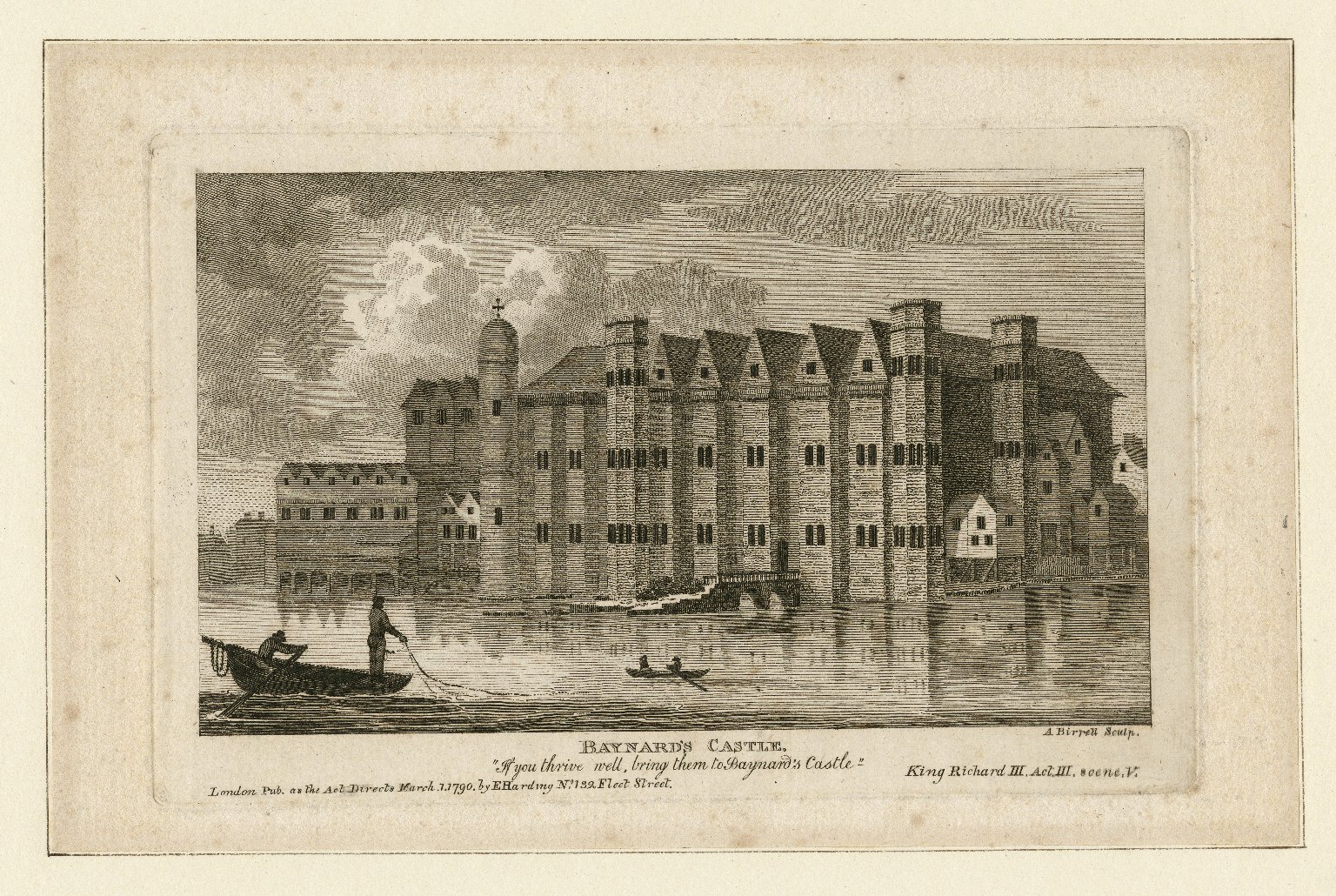
Baynard’s Castle, one of
two most strong Castels(Stow 1:60) in London, has a long and storied history. Located on the banks of the Thames, it was built sometime in the late eleventh century
by Baynard, a Norman who came over with William the Conqueror(Weinreb and Hibbert 129). The castle passed to Baynard’s heirs until one William Baynard,
who by forfeyture for fellonie, lost his Baronie of little Dunmow(Stow 1:61). From the time it was built, Baynard’s Castle was
the headquarters of London’s army until the reign of Edward I (1271-1307) when it was handed over to the Dominican Friars, the Blackfriars whose name is still commemorated along that part of the waterfront(Hibbert 10).
Ownership of the castle changed several times over the first three centuries of
its existence. By 1428, it had been
restored and rebuilt several times, most recently following a fire, and by 1446, the castle had become royal
property (Stow 1:66; Weinreb and Hibbert 129). Once the castle passed to
the monarchy, it became the site of many important events. In 1461, Edward IV was proclaimed king at Baynard’s Castle, where he resided (Stow 1:66; Weinreb and Hibbert 129). Upon Edward’s death, his two sons were mere infants,
incapable of ruling England. In 1483,
Richard [Duke] of Glocester, being elected by the Nobles and Commons in the Guildhall of London, tooke on him the tytle of the Realme and kingdome, as imposed upon him in this Baynards Castle(Stow 1:66). According to tradition, Richard III was offered the crown at Baynard’s by the Duke of Buckingham (Weinreb and Hibbert 129).
After the defeat of Richard III, Henry VII again rebuilt the castle, but in a grand
style more like a palace and less heavily fortified (Stow 1:66–67). His son Henry
VIII reportedly used the castle to host lavish banquets, and to
provide a home for some of his wives. Catharine of Aragon, Anne Boleyn, and
Anne of Cleves all lived at Castle Baynard. Anne of
Cleves was the last member of the royal family to use the castle as a
permanent home (Weinreb and Hibbert
129).
In 1553, Lady Jane Grey and Mary Tudor were both proclaimed queen there (Weinreb and Hibbert 129). Stow gives
the following account of the decision to install Mary as queen:
In the year 1553 the 19. of July, the Counsell partlie moved with the right of the Lady Maries cause, partly considering that the most of the Realme was wholly bent on her side, changing their mind from Lady Jane lately proclaimed Queene, assembled themselves at this Baynardes Castle, where they communed with the Earle of Pembrooke and the Earle of Shrewesbury and Sir John Mason Clearke of the Counsell, sent for the Lord Mayor, and then riding into Cheape to the Crosse, where Gartar King at Armes, Trumpet being sounded, proclaimed the Lady Mary Daughter to king Henry the eight, and Queene Katharen Queene of England, &c. (Stow 1:67)
During Elizabeth’s reign, Baynard’s Castle was owned by the Earl of Pembroke, who entertained the
Queen at a dinner and fireworks display there (Stow 1:67, Weinreb and Hibbert 129).
When the new Lord Mayor took his oath of loyalty to the monarch on 29 October
each year, he was rowed from Westminster to the
city of London along the Thames. Upon disembarking, he would be presented with
the first of the land pageants in the Lord Mayor’s pageants that were written
especially for his installation. In 1613, Sir Hugh Middleton
disembarked at Baynard’s Castle, where part of
Thomas Middleton’s The Triumphs of Truth took place.
Baynard’s Castle was destroyed in the Great Fire
of 1666. Excavations by the
Department of Urban Archaeology between 1972–74 located the foundations of the
castle and one tower (Weinreb and Hibbert 129).
References
-
Citation
Hibbert, Christopher. London: The Biography of a City. Rev. ed. London: Allen Lane, 1977. Print.This item is cited in the following documents:
-
Citation
Stow, John. A Survey of London. Reprinted from the Text of 1603. Ed. Charles Lethbridge Kingsford. 2 vols. Oxford: Clarendon, 1908. See also the digital transcription of this edition at British History Online.This item is cited in the following documents:
-
Citation
Weinreb, Ben, and Christopher Hibbert, eds. The London Encyclopaedia. New York: St. Martin’s P, 1983. Print. [You may also wish to consult the 3rd edition, published in 2008.]This item is cited in the following documents:
Cite this page
MLA citation
.
Baynard’s Castle.The Map of Early Modern London, Edition 7.0, edited by , U of Victoria, 05 May 2022, mapoflondon.uvic.ca/edition/7.0/BAYN1.htm.
Chicago citation
.
Baynard’s Castle.The Map of Early Modern London, Edition 7.0. Ed. . Victoria: University of Victoria. Accessed May 05, 2022. mapoflondon.uvic.ca/edition/7.0/BAYN1.htm.
APA citation
2022. Baynard’s Castle. In (Ed), The Map of Early Modern London (Edition 7.0). Victoria: University of Victoria. Retrieved from https://mapoflondon.uvic.ca/editions/7.0/BAYN1.htm.
RIS file (for RefMan, RefWorks, EndNote etc.)
Provider: University of Victoria
Database: The Map of Early Modern London
Content: text/plain; charset="utf-8"

TY  - ELEC
A1  - Campbell, James
ED  - Jenstad, Janelle
T1  - Baynard’s Castle
T2  - The Map of Early Modern London
ET  - 7.0
PY  - 2022
DA  - 2022/05/05
CY  - Victoria
PB  - University of Victoria
LA  - English
UR  - https://mapoflondon.uvic.ca/edition/7.0/BAYN1.htm
UR  - https://mapoflondon.uvic.ca/edition/7.0/xml/standalone/BAYN1.xml
ER  -
TEI citation
<bibl type="mla"><author><name ref="#CAMP1"><surname>Campbell</surname>, <forename>James</forename></name></author>.
<title level="a">Baynard’s Castle</title>. <title level="m">The Map of Early Modern
London</title>, Edition <edition>7.0</edition>, edited by <editor><name ref="#JENS1"><forename>Janelle</forename>
<surname>Jenstad</surname></name></editor>, <publisher>U of Victoria</publisher>,
<date when="2022-05-05">05 May 2022</date>, <ref target="https://mapoflondon.uvic.ca/edition/7.0/BAYN1.htm">mapoflondon.uvic.ca/edition/7.0/BAYN1.htm</ref>.</bibl>
Personography
-
Joey Takeda
JT
Programmer, 2018-present. Junior Programmer, 2015-2017. Research Assistant, 2014-2017. Joey Takeda was a graduate student at the University of British Columbia in the Department of English (Science and Technology research stream). He completed his BA honours in English (with a minor in Women’s Studies) at the University of Victoria in 2016. His primary research interests included diasporic and indigenous Canadian and American literature, critical theory, cultural studies, and the digital humanities.Roles played in the project
-
Abstract Author
-
Author
-
CSS Editor
-
Compiler
-
Conceptor
-
Copy Editor
-
Editor
-
Encoder
-
Geo-Coordinate Researcher
-
Junior Programmer
-
Markup Editor
-
Post-Conversion Editor
-
Programmer
-
Proofreader
-
Researcher
-
Toponymist
-
Transcriber
-
Transcription Proofreader
Contributions by this author
Joey Takeda is a member of the following organizations and/or groups:
Joey Takeda is mentioned in the following documents:
Joey Takeda authored or edited the following items in MoEML’s bibliography:
-
Jenstad, Janelle and Joseph Takeda.
Making the RA Matter: Pedagogy, Interface, and Practices.
Making Things and Drawing Boundaries: Experiments in the Digital Humanities. Ed. Jentery Sayers. Minnesota: University of Minnesota Press, 2018. Print.
-
-
Tye Landels-Gruenewald
TLG
Data Manager, 2015-2016. Research Assistant, 2013-2015. Tye completed his undergraduate honours degree in English at the University of Victoria in 2015.Roles played in the project
-
Author
-
CSS Editor
-
Compiler
-
Conceptor
-
Copy Editor
-
Data Manager
-
Editor
-
Encoder
-
Geo-Coordinate Researcher
-
Markup Editor
-
Metadata Architect
-
Proofreader
-
Researcher
-
Toponymist
-
Transcriber
-
Transcription Proofreader
Contributions by this author
Tye Landels-Gruenewald is a member of the following organizations and/or groups:
Tye Landels-Gruenewald is mentioned in the following documents:
-
-
James Campbell
JDC
Research Assistant, 2002–2003. Student contributor enrolled in English 412: Representations of London at the University of Windsor in Fall 2002. BA honours student, English Language and Literature, University of Windsor.Roles played in the project
-
Author
-
Transcriber
Contributions by this author
James Campbell is a member of the following organizations and/or groups:
James Campbell is mentioned in the following documents:
-
-
Melanie Chernyk
MJC
Research Assistant, 2004–2008. BA honours, 2006. MA English, University of Victoria, 2007. Melanie Chernyk went on to work at the Electronic Textual Cultures Lab at the University of Victoria and now manages Talisman Books and Gallery on Pender Island, BC. She also has her own editing business at http://26letters.ca.Roles played in the project
-
Author
-
Compiler
-
Copy Editor
-
Encoder
-
Researcher
-
Toponymist
-
Transcriber
Contributions by this author
Melanie Chernyk is a member of the following organizations and/or groups:
Melanie Chernyk is mentioned in the following documents:
-
-
Sarah Milligan
SM
Research Assistant, 2012-2014. MoEML Research Affiliate. Sarah Milligan completed her MA at the University of Victoria in 2012 on the invalid persona in Elizabeth Barrett Browning’s Sonnets from the Portuguese. She has also worked with the Internet Shakespeare Editions and with Dr. Alison Chapman on the Victorian Poetry Network, compiling an index of Victorian periodical poetry.Roles played in the project
-
Author
-
Compiler
-
Copy Editor
-
Editor
-
Encoder
-
Markup Editor
-
Researcher
-
Toponymist
-
Transcriber
Contributions by this author
Sarah Milligan is a member of the following organizations and/or groups:
Sarah Milligan is mentioned in the following documents:
-
-
Kim McLean-Fiander
KMF
Director of Pedagogy and Outreach, 2015–2020. Associate Project Director, 2015. Assistant Project Director, 2013-2014. MoEML Research Fellow, 2013. Kim McLean-Fiander comes to The Map of Early Modern London from the Cultures of Knowledge digital humanities project at the University of Oxford, where she was the editor of Early Modern Letters Online, an open-access union catalogue and editorial interface for correspondence from the sixteenth to eighteenth centuries. She is currently Co-Director of a sister project to EMLO called Women’s Early Modern Letters Online (WEMLO). In the past, she held an internship with the curator of manuscripts at the Folger Shakespeare Library, completed a doctorate at Oxford on paratext and early modern women writers, and worked a number of years for the Bodleian Libraries and as a freelance editor. She has a passion for rare books and manuscripts as social and material artifacts, and is interested in the development of digital resources that will improve access to these materials while ensuring their ongoing preservation and conservation. An avid traveler, Kim has always loved both London and maps, and so is particularly delighted to be able to bring her early modern scholarly expertise to bear on the MoEML project.Roles played in the project
-
Associate Project Director
-
Author
-
CSS Editor
-
Compiler
-
Conceptor
-
Copy Editor
-
Data Manager
-
Director of Pedagogy and Outreach
-
Editor
-
Encoder
-
Geo-Coordinate Researcher
-
Managing Editor
-
Markup Editor
-
Metadata Architect
-
Research Fellow
-
Toponymist
-
Transcriber
-
Transcription Proofreader
-
Vetter
Contributions by this author
Kim McLean-Fiander is a member of the following organizations and/or groups:
Kim McLean-Fiander is mentioned in the following documents:
-
-
Janelle Jenstad
JJ
Janelle Jenstad is Associate Professor of English at the University of Victoria, Director of The Map of Early Modern London, and PI of Linked Early Modern Drama Online. She has taught at Queen’s University, the Summer Academy at the Stratford Festival, the University of Windsor, and the University of Victoria. With Jennifer Roberts-Smith and Mark Kaethler, she co-edited Shakespeare’s Language in Digital Media (Routledge). She has prepared a documentary edition of John Stow’s A Survey of London (1598 text) for MoEML and is currently editing The Merchant of Venice (with Stephen Wittek) and Heywood’s 2 If You Know Not Me You Know Nobody for DRE. Her articles have appeared in Digital Humanities Quarterly, Renaissance and Reformation,Journal of Medieval and Early Modern Studies, Early Modern Literary Studies, Elizabethan Theatre, Shakespeare Bulletin: A Journal of Performance Criticism, and The Silver Society Journal. Her book chapters have appeared (or will appear) in Institutional Culture in Early Modern Society (Brill, 2004), Shakespeare, Language and the Stage, The Fifth Wall: Approaches to Shakespeare from Criticism, Performance and Theatre Studies (Arden/Thomson Learning, 2005), Approaches to Teaching Othello (Modern Language Association, 2005), Performing Maternity in Early Modern England (Ashgate, 2007), New Directions in the Geohumanities: Art, Text, and History at the Edge of Place (Routledge, 2011), Early Modern Studies and the Digital Turn (Iter, 2016), Teaching Early Modern English Literature from the Archives (MLA, 2015), Placing Names: Enriching and Integrating Gazetteers (Indiana, 2016), Making Things and Drawing Boundaries (Minnesota, 2017), and Rethinking Shakespeare’s Source Study: Audiences, Authors, and Digital Technologies (Routledge, 2018).Roles played in the project
-
Abstract Author
-
Author
-
Author (Preface)
-
Author of Preface
-
Compiler
-
Conceptor
-
Copy Editor
-
Course Instructor
-
Course Supervisor
-
Data Manager
-
Editor
-
Encoder
-
Geo-Coordinate Researcher
-
Markup Editor
-
Peer Reviewer
-
Project Director
-
Proofreader
-
Researcher
-
Toponymist
-
Transcriber
-
Transcription Proofreader
-
Vetter
Contributions by this author
Janelle Jenstad is a member of the following organizations and/or groups:
Janelle Jenstad is mentioned in the following documents:
Janelle Jenstad authored or edited the following items in MoEML’s bibliography:
-
Jenstad, Janelle and Joseph Takeda.
Making the RA Matter: Pedagogy, Interface, and Practices.
Making Things and Drawing Boundaries: Experiments in the Digital Humanities. Ed. Jentery Sayers. Minnesota: University of Minnesota Press, 2018. Print. -
Jenstad, Janelle.
Building a Gazetteer for Early Modern London, 1550-1650.
Placing Names. Ed. Merrick Lex Berman, Ruth Mostern, and Humphrey Southall. Bloomington and Indianapolis: Indiana UP, 2016. 129-145. -
Jenstad, Janelle.
The Burse and the Merchant’s Purse: Coin, Credit, and the Nation in Heywood’s 2 If You Know Not Me You Know Nobody.
The Elizabethan Theatre XV. Ed. C.E. McGee and A.L. Magnusson. Toronto: P.D. Meany, 2002. 181–202. Print. -
Jenstad, Janelle.
Early Modern Literary Studies 8.2 (2002): 5.1–26..The City Cannot Hold You
: Social Conversion in the Goldsmith’s Shop. -
Jenstad, Janelle.
The Silver Society Journal 10 (1998): 40–43.The Gouldesmythes Storehowse
: Early Evidence for Specialisation. -
Jenstad, Janelle.
Lying-in Like a Countess: The Lisle Letters, the Cecil Family, and A Chaste Maid in Cheapside.
Journal of Medieval and Early Modern Studies 34 (2004): 373–403. doi:10.1215/10829636–34–2–373. -
Jenstad, Janelle.
Public Glory, Private Gilt: The Goldsmiths’ Company and the Spectacle of Punishment.
Institutional Culture in Early Modern Society. Ed. Anne Goldgar and Robert Frost. Leiden: Brill, 2004. 191–217. Print. -
Jenstad, Janelle.
Smock Secrets: Birth and Women’s Mysteries on the Early Modern Stage.
Performing Maternity in Early Modern England. Ed. Katherine Moncrief and Kathryn McPherson. Aldershot: Ashgate, 2007. 87–99. Print. -
Jenstad, Janelle.
Using Early Modern Maps in Literary Studies: Views and Caveats from London.
GeoHumanities: Art, History, Text at the Edge of Place. Ed. Michael Dear, James Ketchum, Sarah Luria, and Doug Richardson. London: Routledge, 2011. Print. -
Jenstad, Janelle.
Versioning John Stow’s A Survey of London, or, What’s New in 1618 and 1633?.
Janelle Jenstad Blog. https://janellejenstad.com/2013/03/20/versioning-john-stows-a-survey-of-london-or-whats-new-in-1618-and-1633/. -
Shakespeare, William. The Merchant of Venice. Ed. Janelle Jenstad. Internet Shakespeare Editions. U of Victoria. http://internetshakespeare.uvic.ca/Library/Texts/MV/.
-
Stow, John. A SVRVAY OF LONDON. Contayning the Originall, Antiquity, Increase, Moderne estate, and description of that Citie, written in the yeare 1598. by Iohn Stow Citizen of London. Also an Apologie (or defence) against the opinion of some men, concerning that Citie, the greatnesse thereof. With an Appendix, containing in Latine, Libellum de situ & nobilitate Londini: written by William Fitzstephen, in the raigne of Henry the second. Ed. Janelle Jenstad and the MoEML Team. MoEML. Transcribed.
-
-
Stewart Arneil
Programmer at the University of Victoria Humanities Computing and Media Centre (HCMC) who maintained the Map of London project between 2006 and 2011. Stewart was a co-applicant on the SSHRC Insight Grant for 2012–16.Roles played in the project
-
Programmer
Stewart Arneil is a member of the following organizations and/or groups:
Stewart Arneil is mentioned in the following documents:
-
-
Martin D. Holmes
MDH
Programmer at the University of Victoria Humanities Computing and Media Centre (HCMC). Martin ported the MOL project from its original PHP incarnation to a pure eXist database implementation in the fall of 2011. Since then, he has been lead programmer on the project and has also been responsible for maintaining the project schemas. He was a co-applicant on MoEML’s 2012 SSHRC Insight Grant.Roles played in the project
-
Abstract Author
-
Author
-
Conceptor
-
Editor
-
Encoder
-
Geo-Coordinate Researcher
-
Markup Editor
-
Post-Conversion Editor
-
Programmer
-
Proofreader
-
Researcher
Contributions by this author
Martin D. Holmes is a member of the following organizations and/or groups:
Martin D. Holmes is mentioned in the following documents:
-
-
Anne Boleyn is mentioned in the following documents:
-
Catherine of Aragon is mentioned in the following documents:
-
Ralph Baynard is mentioned in the following documents:
-
William Baynard is mentioned in the following documents:
-
Anne of Cleves is mentioned in the following documents:
-
Edward I
Edward This numeral is a Roman numeral. The Arabic equivalent is 1I King of England Longshanks Hammer of the Scots
(b. between 17 June 1239 and 18 June 1239, d. in or before 27 October 1307)Edward I is mentioned in the following documents:
-
Edward IV
Edward This numeral is a Roman numeral. The Arabic equivalent is 4IV King of England
(b. 28 April 1442, d. 9 April 1483)Edward IV is mentioned in the following documents:
-
Elizabeth I
Elizabeth This numeral is a Roman numeral. The Arabic equivalent is 1I Queen of England Queen of Ireland Gloriana Good Queen Bess
(b. 7 September 1533, d. 24 March 1603)Queen of England and Ireland 1558-1603.Elizabeth I is mentioned in the following documents:
-
Lady Jane Grey (née Dudley)
Lady Jane Grey Dudley
(b. 1537, d. 1554)Contested Queen of England from 10 July to 19 July 1553.Lady Jane Grey (née Dudley) is mentioned in the following documents:
-
Henry VIII
Henry This numeral is a Roman numeral. The Arabic equivalent is 8VIII King of England King of Ireland
(b. 28 June 1491, d. 28 January 1547)King of England and Ireland 1509-1547.Henry VIII is mentioned in the following documents:
-
Henry VII
Henry This numeral is a Roman numeral. The Arabic equivalent is 7VII King of England
(b. 1457, d. 1509)Henry VII is mentioned in the following documents:
-
Henry Herbert
(b. in or after 1538, d. 1601)Second Earl of Pembroke. Son of William Herbert. Father of William Herbert.Henry Herbert is mentioned in the following documents:
-
William Herbert
(b. 1580, d. 1630)Third Earl of Pembroke. Son of Henry Herbert. Brother of Phillip Herbert. Dedicatee of William Shakespeare’s First Folio.William Herbert is mentioned in the following documents:
-
Mary I
Mary This numeral is a Roman numeral. The Arabic equivalent is 1I Queen of England Queen of Ireland
(b. 18 February 1516, d. 17 November 1558)Mary I is mentioned in the following documents:
-
Sir John Mason
(b. 1503, d. 1566)Diplomat and Member of Parliament. Not to be confused with John Mason or John Mason.Sir John Mason is mentioned in the following documents:
-
Thomas Middleton is mentioned in the following documents:
Thomas Middleton authored or edited the following items in MoEML’s bibliography:
-
Bawcutt, N.W., ed.
Introduction.
The Changeling. By Thomas Middleton and William Rowley. London: Methuen, 1958. Print. -
Brissenden, Alan.
Introduction.
A Chaste Maid in Cheapside. By Thomas Middleton. 2nd ed. New Mermaids. London: A&C Black; New York: Norton, 2002. xi–xxxv. Print. -
Daalder, Joost, ed.
Introduction.
The Changeling. By Thomas Middleton and William Rowley. London: A&C Black, 1990. xii-xiii. Print. -
Dekker, Thomas, Stephen Harrison, Ben Jonson, and Thomas Middleton. The Whole Royal and Magnificent Entertainment of King James through the City of London, 15 March 1604, with the Arches of Triumph. Ed. R. Malcolm Smuts. Thomas Middleton: The Collected Works. Gen. ed. Gary Taylor and John Lavagnino. Oxford: Oxford UP, 2007. 219–279. Print.
-
Holdsworth, R.V., ed.
Introduction.
A Fair Quarrel. By Thomas Middleton and William Rowley. London: Ernest Benn, 1974. xi-xxxix. Print. -
Middleton, Thomas, and Thomas Dekker. The Roaring Girl. Ed. Paul A. Mulholland. Revels Plays. Manchester: Manchester UP, 1987. Print.
-
Middleton, Thomas. A Chaste Maid in Cheapside. Ed. Alan Brissenden. 2nd ed. New Mermaids. London: Benn, 2002.
-
Middleton, Thomas. Civitatis Amor. Ed. David Bergeron. Thomas Middleton: The Collected Works. Gen. ed. Gary Taylor and John Lavagnino. Oxford: Oxford UP, 2007. 1202–8.
-
Middleton, Thomas. The Triumphs of Honour and Industry. London: Printed by Nicholas Okes, 1617. STC 17899.
-
Middleton, Thomas. The Triumphs of Integrity. Ed. David Bergeron. Thomas Middleton: The Collected Works. Gen. ed. Gary Taylor and John Lavagnino. Oxford: Oxford UP, 2007. 1766–1771.
-
Middleton, Thomas. The Triumphs of Love and Antiquity. London: Printed by Nicholas Okes, 1619. STC 17902.
-
Middleton, Thomas. The Triumphs of Truth. London, 1613. Ed. David M. Bergeron. Thomas Middleton: The Collected Works. Ed. Gary Taylor and John Lavagnino. Oxford: Clarendon, 2007. 968–976.
-
Middleton, Thomas. The Triumphs of Truth. London, 1613. STC 17903. [Differs from STC 17904 in that it does not contain the additional entertainment.]
-
Middleton, Thomas. The Triumphs of Truth. London, 1613. STC 17904. [Differs from STC 17903 in that it contains an additional entertainment celebrating Hugh Middleton’s New River project, known as the Entertainment at Amwell Head.]
-
Middleton, Thomas. The Works of Thomas Middleton, now First Collected with Some Account of the Author and notes by The Reverend Alexander Dyce. Ed. Alexander Dyce. London: E. Lumley, 1840. Print.
-
Taylor, Gary, and John Lavagnino, eds. Thomas Middleton: The Collected Works. By Thomas Middleton. Oxford: Oxford UP, 2007. The Oxford Middleton. Print.
-
Sir Hugh Middleton is mentioned in the following documents:
-
Richard III
Richard This numeral is a Roman numeral. The Arabic equivalent is 3III King of England
(b. 1452, d. 1485)King of England and Lord of Ireland 1483-1485.Richard III is mentioned in the following documents:
-
Henry Stafford is mentioned in the following documents:
-
John Stow
(b. between 1524 and 1525, d. 1605)Historian and author of A Survey of London. Husband of Elizabeth Stow.John Stow is mentioned in the following documents:
John Stow authored or edited the following items in MoEML’s bibliography:
-
Blome, Richard.
Aldersgate Ward and St. Martins le Grand Liberty Taken from the Last Survey, with Corrections.
A Survey of the Cities of London and Westminster: Containing the Original, Antiquity, Increase, Modern Estate and Government of those Cities. By John Stow and John Strype. Vol. 1. London: A. Churchill, J. Knapton, R. Knaplock, J. Walthoe, E. Horne, B. Tooke, D. Midwinter, B. Cowse, R. Robinson, and T. Ward, 1720. Insert between sig. M3r and sig. M4v. [See more information about this map.] -
Blome, Richard.
Aldgate Ward with its Division into Parishes. Taken from the Last Survey, with Corrections & Additions.
A Survey of the Cities of London and Westminster: Containing the Original, Antiquity, Increase, Modern Estate and Government of those Cities. By John Stow and John Strype. Vol. 1. London: A. Churchill, J. Knapton, R. Knaplock, J. Walthoe, E. Horne, B. Tooke, D. Midwinter, B. Cowse, R. Robinson, and T. Ward, 1720. Insert between sig. H3r and sig. H4v. [See more information about this map.] -
Blome, Richard.
Billingsgate Ward and Bridge Ward Within with it’s Division into Parishes, Taken from the Last Survey.
A Survey of the Cities of London and Westminster: Containing the Original, Antiquity, Increase, Modern Estate and Government of those Cities. By John Stow and John Strype. Vol. 1. London: A. Churchill, J. Knapton, R. Knaplock, J. Walthoe, E. Horne, B. Tooke, D. Midwinter, B. Cowse, R. Robinson, and T. Ward, 1720. Insert between sig. Y2r and sig. Y3v. [See more information about this map.] -
Blome, Richard.
Bishopsgate-street Ward. Taken from the Last Survey and Corrected.
A Survey of the Cities of London and Westminster: Containing the Original, Antiquity, Increase, Modern Estate and Government of those Cities. By John Stow and John Strype. Vol. 1. London: A. Churchill, J. Knapton, R. Knaplock, J. Walthoe, E. Horne, B. Tooke, D. Midwinter, B. Cowse, R. Robinson, and T. Ward, 1720. Insert between sig. N1r and sig. N2v. [See more information about this map.] -
Blome, Richard.
Bread Street Ward and Cardwainter Ward with its Division into Parishes Taken from the Last Survey.
A Survey of the Cities of London and Westminster: Containing the Original, Antiquity, Increase, Modern Estate and Government of those Cities. By John Stow and John Strype. Vol. 1. London: A. Churchill, J. Knapton, R. Knaplock, J. Walthoe, E. Horne, B. Tooke, D. Midwinter, B. Cowse, R. Robinson, and T. Ward, 1720. Insert between sig. B3r and sig. B4v. [See more information about this map.] -
Blome, Richard.
Broad Street Ward with its Division into Parishes, Taken from the Last Survey with Corrections and Additions, & Cornhill Ward with its Divisions into Parishes, Taken from the Last Survey, &c.
A Survey of the Cities of London and Westminster: Containing the Original, Antiquity, Increase, Modern Estate and Government of those Cities. By John Stow and John Strype. Vol. 1. London: A. Churchill, J. Knapton, R. Knaplock, J. Walthoe, E. Horne, B. Tooke, D. Midwinter, B. Cowse, R. Robinson, and T. Ward, 1720. Insert between sig. P2r and sig. P3v. [See more information about this map.] -
Blome, Richard.
Cheape Ward with its Division into Parishes, Taken from the Last Survey, with Corrections and Additions.
A Survey of the Cities of London and Westminster: Containing the Original, Antiquity, Increase, Modern Estate and Government of those Cities. By John Stow and John Strype. Vol. 1. London: A. Churchill, J. Knapton, R. Knaplock, J. Walthoe, E. Horne, B. Tooke, D. Midwinter, B. Cowse, R. Robinson, and T. Ward, 1720. Insert between sig.D1r and sig. D2v. [See more information about this map.] -
Blome, Richard.
Coleman Street Ward and Bashishaw Ward Taken from the Last Survey with Corrections and Additions.
A Survey of the Cities of London and Westminster: Containing the Original, Antiquity, Increase, Modern Estate and Government of those Cities. By John Stow and John Strype. Vol. 1. London: A. Churchill, J. Knapton, R. Knaplock, J. Walthoe, E. Horne, B. Tooke, D. Midwinter, B. Cowse, R. Robinson, and T. Ward, 1720. Insert between sig. G2r and sig. G3v. [See more information about this map.] -
Blome, Richard.
Cow Cross being St Sepulchers Parish Without and the Charterhouse.
A Survey of the Cities of London and Westminster: Containing the Original, Antiquity, Increase, Modern Estate and Government of those Cities. By John Stow and John Strype. Vol. 2. London: A. Churchill, J. Knapton, R. Knaplock, J. Walthoe, E. Horne, B. Tooke, D. Midwinter, B. Cowse, R. Robinson, and T. Ward, 1720. Insert between sig. H2v and sig. H3r. [See more information about this map.] -
Blome, Richard.
Creplegate Ward with its Division into Parishes, Taken from the Last Survey, with Additions, and Corrections.
A Survey of the Cities of London and Westminster: Containing the Original, Antiquity, Increase, Modern Estate and Government of those Cities. By John Stow and John Strype. Vol. 1. London: A. Churchill, J. Knapton, R. Knaplock, J. Walthoe, E. Horne, B. Tooke, D. Midwinter, B. Cowse, R. Robinson, and T. Ward, 1720. Insert between sig. I3r and sig. I4v. [See more information about this map.] -
Blome, Richard.
Farrington Ward Without, with its Division into Parishes, Taken from the Last Survey with Corrections & Amendments.
A Survey of the Cities of London and Westminster: Containing the Original, Antiquity, Increase, Modern Estate and Government of those Cities. By John Stow and John Strype. Vol. 1. London: A. Churchill, J. Knapton, R. Knaplock, J. Walthoe, E. Horne, B. Tooke, D. Midwinter, B. Cowse, R. Robinson, and T. Ward, 1720. Insert between sig. 2F3r and sig. 2F4v. [See more information about this map.] -
Blome, Richard.
Lambeth and Christ Church Parish Southwark. Taken from ye last Survey with Corrections.
A Survey of the Cities of London and Westminster: Containing the Original, Antiquity, Increase, Modern Estate and Government of those Cities. By John Stow and John Strype. Vol. 2. London: A. Churchill, J. Knapton, R. Knaplock, J. Walthoe, E. Horne, B. Tooke, D. Midwinter, B. Cowse, R. Robinson, and T. Ward, 1720. Insert between sig. Z1r and sig. Z2r. [See more information about this map.] -
Blome, Richard.
Langborne Ward with its Division into Parishes. Corrected from the Last Survey. & Candlewick Ward with its Division into Parishes. Corrected from the Last Survey.
A Survey of the Cities of London and Westminster: Containing the Original, Antiquity, Increase, Modern Estate and Government of those Cities. By John Stow and John Strype. Vol. 1. London: A. Churchill, J. Knapton, R. Knaplock, J. Walthoe, E. Horne, B. Tooke, D. Midwinter, B. Cowse, R. Robinson, and T. Ward, 1720. Insert between sig. U3r and sig. U4v. [See more information about this map.] -
Blome, Richard.
A Map of St. Gilles’s Cripple Gate. Without. With Large Additions and Corrections.
A Survey of the Cities of London and Westminster: Containing the Original, Antiquity, Increase, Modern Estate and Government of those Cities. By John Stow and John Strype. Vol. 2. London: A. Churchill, J. Knapton, R. Knaplock, J. Walthoe, E. Horne, B. Tooke, D. Midwinter, B. Cowse, R. Robinson, and T. Ward, 1720. Insert between sig. H2v and sig. H3r. [See more information about this map.] -
Blome, Richard.
A Map of the Parish of St. Dunstans Stepney, als. Stebunheath Divided into Hamlets.
A Survey of the Cities of London and Westminster: Containing the Original, Antiquity, Increase, Modern Estate and Government of those Cities. By John Stow and John Strype. Vol. 2. London: A. Churchill, J. Knapton, R. Knaplock, J. Walthoe, E. Horne, B. Tooke, D. Midwinter, B. Cowse, R. Robinson, and T. Ward, 1720. Insert between sig. F3r and sig. F4v. [See more information about this map.] -
Blome, Richard.
A Map of the Parish of St Mary White Chappel and a Map of the Parish of St Katherines by the Tower.
A Survey of the Cities of London and Westminster: Containing the Original, Antiquity, Increase, Modern Estate and Government of those Cities. By John Stow and John Strype. Vol. 2. London: A. Churchill, J. Knapton, R. Knaplock, J. Walthoe, E. Horne, B. Tooke, D. Midwinter, B. Cowse, R. Robinson, and T. Ward, 1720. Insert between sig. F2r and sig. F3v. [See more information about this map.] -
Blome, Richard.
A Mapp of Lime Street Ward. Taken from ye Last Surveys & Corrected.
A Survey of the Cities of London and Westminster: Containing the Original, Antiquity, Increase, Modern Estate and Government of those Cities. By John Stow and John Strype. Vol. 1. London: A. Churchill, J. Knapton, R. Knaplock, J. Walthoe, E. Horne, B. Tooke, D. Midwinter, B. Cowse, R. Robinson, and T. Ward, 1720. Insert between sig. M1r and sig. M2v. [See more information about this map.] -
Blome, Richard.
A Mapp of St. Andrews Holborn Parish as well Within the Liberty as Without.
A Survey of the Cities of London and Westminster: Containing the Original, Antiquity, Increase, Modern Estate and Government of those Cities. By John Stow and John Strype. Vol. 1. London: A. Churchill, J. Knapton, R. Knaplock, J. Walthoe, E. Horne, B. Tooke, D. Midwinter, B. Cowse, R. Robinson, and T. Ward, 1720. Insert between sig. 2I1r and sig. 2I2v. [See more information about this map.] -
Blome, Richard.
A Mapp of the Parishes of St. Clements Danes, St. Mary Savoy; with the Rolls Liberty and Lincolns Inn, Taken from the Last Survey with Corrections and Additions.
A Survey of the Cities of London and Westminster: Containing the Original, Antiquity, Increase, Modern Estate and Government of those Cities. By John Stow and John Strype. Vol. 2. London: A. Churchill, J. Knapton, R. Knaplock, J. Walthoe, E. Horne, B. Tooke, D. Midwinter, B. Cowse, R. Robinson, and T. Ward, 1720. Insert between sig.O4v and sig. O1r. [See more information about this map.] -
Blome, Richard.
A Mapp of the Parish of St. Anns. Taken from the last Survey, with Correction, and Additions.
A Survey of the Cities of London and Westminster: Containing the Original, Antiquity, Increase, Modern Estate and Government of those Cities. By John Stow and John Strype. Vol. 2. London: A. Churchill, J. Knapton, R. Knaplock, J. Walthoe, E. Horne, B. Tooke, D. Midwinter, B. Cowse, R. Robinson, and T. Ward, 1720. Insert between sig. L2v and sig. L3r. [See more information about this map.] -
Blome, Richard.
A Mapp of the Parish of St. Giles’s in the Fields Taken from the Last Servey, with Corrections and Additions.
A Survey of the Cities of London and Westminster: Containing the Original, Antiquity, Increase, Modern Estate and Government of those Cities. By John Stow and John Strype. Vol. 2. London: A. Churchill, J. Knapton, R. Knaplock, J. Walthoe, E. Horne, B. Tooke, D. Midwinter, B. Cowse, R. Robinson, and T. Ward, 1720. Insert between sig. K1v and sig. K2r. [See more information about this map.] -
Blome, Richard.
A Mapp of the Parish of St Margarets Westminster Taken from the Last Survey with Corrections.
A Survey of the Cities of London and Westminster: Containing the Original, Antiquity, Increase, Modern Estate and Government of those Cities. By John Stow and John Strype. Vol. 2. London: A. Churchill, J. Knapton, R. Knaplock, J. Walthoe, E. Horne, B. Tooke, D. Midwinter, B. Cowse, R. Robinson, and T. Ward, 1720. Insert between sig.H3v and sig. H4r. [See more information about this map.] -
Blome, Richard.
A Mapp of the Parish of St Martins in the Fields Taken from ye Last Survey with Additions.
A Survey of the Cities of London and Westminster: Containing the Original, Antiquity, Increase, Modern Estate and Government of those Cities. By John Stow and John Strype. Vol. 2. London: A. Churchill, J. Knapton, R. Knaplock, J. Walthoe, E. Horne, B. Tooke, D. Midwinter, B. Cowse, R. Robinson, and T. Ward, 1720. Insert between sig. I1v and sig. I2r. [See more information about this map.] -
Blome, Richard.
A Mapp of the Parish of St Pauls Covent Garden Taken from the Last Survey.
A Survey of the Cities of London and Westminster: Containing the Original, Antiquity, Increase, Modern Estate and Government of those Cities. By John Stow and John Strype. Vol. 2. London: A. Churchill, J. Knapton, R. Knaplock, J. Walthoe, E. Horne, B. Tooke, D. Midwinter, B. Cowse, R. Robinson, and T. Ward, 1720. Insert between sig. L3v and sig. L4r. [See more information about this map.] -
Blome, Richard.
A Mapp of the Parish of St Saviours Southwark and St Georges taken from ye last Survey.
A Survey of the Cities of London and Westminster: Containing the Original, Antiquity, Increase, Modern Estate and Government of those Cities. By John Stow and John Strype. Vol. 1. London: A. Churchill, J. Knapton, R. Knaplock, J. Walthoe, E. Horne, B. Tooke, D. Midwinter, B. Cowse, R. Robinson, and T. Ward, 1720. Insert between sig. D1r and sig.D2v. [See more information about this map.] -
Blome, Richard.
The Parish of St. James Clerkenwell taken from ye last Survey with Corrections.
A Survey of the Cities of London and Westminster: Containing the Original, Antiquity, Increase, Modern Estate and Government of those Cities. By John Stow and John Strype. Vol. 2. London: A. Churchill, J. Knapton, R. Knaplock, J. Walthoe, E. Horne, B. Tooke, D. Midwinter, B. Cowse, R. Robinson, and T. Ward, 1720. Insert between sig. H3v and sig. H4r. [See more information about this map.] -
Blome, Richard.
The Parish of St. James’s, Westminster Taken from the Last Survey with Corrections.
A Survey of the Cities of London and Westminster: Containing the Original, Antiquity, Increase, Modern Estate and Government of those Cities. By John Stow and John Strype. Vol. 2. London: A. Churchill, J. Knapton, R. Knaplock, J. Walthoe, E. Horne, B. Tooke, D. Midwinter, B. Cowse, R. Robinson, and T. Ward, 1720. Insert between sig. K4v and sig. L1r. [See more information about this map.] -
Blome, Richard.
The Parish of St Johns Wapping. The Parish of St Paul Shadwell.
A Survey of the Cities of London and Westminster: Containing the Original, Antiquity, Increase, Modern Estate and Government of those Cities. By John Stow and John Strype. Vol. 2. London: A. Churchill, J. Knapton, R. Knaplock, J. Walthoe, E. Horne, B. Tooke, D. Midwinter, B. Cowse, R. Robinson, and T. Ward, 1720. Insert between sig. E2r and sig. E3v. [See more information about this map.] -
Blome, Richard.
Portsoken Ward being Part of the Parish of St. Buttolphs Aldgate, taken from the Last Survey, with Corrections and Additions.
A Survey of the Cities of London and Westminster: Containing the Original, Antiquity, Increase, Modern Estate and Government of those Cities. By John Stow and John Strype. Vol. 1. London: A. Churchill, J. Knapton, R. Knaplock, J. Walthoe, E. Horne, B. Tooke, D. Midwinter, B. Cowse, R. Robinson, and T. Ward, 1720. Insert between sig. B1v and sig. B2r. [See more information about this map.] -
Blome, Richard.
Queen Hith Ward and Vintry Ward with their Division into Parishes, Taken from the Last Survey.
A Survey of the Cities of London and Westminster: Containing the Original, Antiquity, Increase, Modern Estate and Government of those Cities. By John Stow and John Strype. Vol. 1. London: A. Churchill, J. Knapton, R. Knaplock, J. Walthoe, E. Horne, B. Tooke, D. Midwinter, B. Cowse, R. Robinson, and T. Ward, 1720. Insert between sig. 2C4r and sig. 2D1v. [See more information about this map.] -
Blome, Richard.
Shoreditch Norton Folgate, and Crepplegate Without Taken from ye Last Survey with Corrections.
A Survey of the Cities of London and Westminster: Containing the Original, Antiquity, Increase, Modern Estate and Government of those Cities. By John Stow and John Strype. Vol. 2. London: A. Churchill, J. Knapton, R. Knaplock, J. Walthoe, E. Horne, B. Tooke, D. Midwinter, B. Cowse, R. Robinson, and T. Ward, 1720. Insert between sig. G1r and sig. G2v. [See more information about this map.] -
Blome, Richard.
Spittle Fields and Places Adjacent Taken from ye Last Survey with Corrections.
A Survey of the Cities of London and Westminster: Containing the Original, Antiquity, Increase, Modern Estate and Government of those Cities. By John Stow and John Strype. Vol. 2. London: A. Churchill, J. Knapton, R. Knaplock, J. Walthoe, E. Horne, B. Tooke, D. Midwinter, B. Cowse, R. Robinson, and T. Ward, 1720. Insert between sig. F4r and sig. G1v. [See more information about this map.] -
Blome, Richard.
St. Olave and St. Mary Magdalens Bermondsey Southwark Taken from ye last Survey with Corrections.
A Survey of the Cities of London and Westminster: Containing the Original, Antiquity, Increase, Modern Estate and Government of those Cities. By John Stow and John Strype. Vol. 1. London: A. Churchill, J. Knapton, R. Knaplock, J. Walthoe, E. Horne, B. Tooke, D. Midwinter, B. Cowse, R. Robinson, and T. Ward, 1720. Insert between sig. C2r and sig.C3v. [See more information about this map.] -
Blome, Richard.
Tower Street Ward with its Division into Parishes, Taken from the Last Survey, with Corrections.
A Survey of the Cities of London and Westminster: Containing the Original, Antiquity, Increase, Modern Estate and Government of those Cities. By John Stow and John Strype. Vol. 1. London: A. Churchill, J. Knapton, R. Knaplock, J. Walthoe, E. Horne, B. Tooke, D. Midwinter, B. Cowse, R. Robinson, and T. Ward, 1720. Insert between sig. E2r and sig. E3v. [See more information about this map.] -
Blome, Richard.
Walbrook Ward and Dowgate Ward with its Division into Parishes, Taken from the Last Surveys.
A Survey of the Cities of London and Westminster: Containing the Original, Antiquity, Increase, Modern Estate and Government of those Cities. By John Stow and John Strype. Vol. 1. London: A. Churchill, J. Knapton, R. Knaplock, J. Walthoe, E. Horne, B. Tooke, D. Midwinter, B. Cowse, R. Robinson, and T. Ward, 1720. Insert between sig. 2B3r and sig. 2B4v. [See more information about this map.] -
Blome, Richard.
The Wards of Farington Within and Baynards Castle with its Divisions into Parishes, Taken from the Last Survey, with Corrections.
A Survey of the Cities of London and Westminster: Containing the Original, Antiquity, Increase, Modern Estate and Government of those Cities. By John Stow and John Strype. Vol. 1. London: A. Churchill, J. Knapton, R. Knaplock, J. Walthoe, E. Horne, B. Tooke, D. Midwinter, B. Cowse, R. Robinson, and T. Ward, 1720. Insert between sig. Q2r and sig. Q3v. [See more information about this map.] -
The City of London as in Q. Elizabeth’s Time.
A Survey of the Cities of London and Westminster: Containing the Original, Antiquity, Increase, Modern Estate and Government of those Cities. By John Stow and John Strype. Vol. 1. London: A. Churchill, J. Knapton, R. Knaplock, J. Walthoe, E. Horne, B. Tooke, D. Midwinter, B. Cowse, R. Robinson, and T. Ward, 1720. Frontispiece. -
A Map of the Tower Liberty.
A Survey of the Cities of London and Westminster: Containing the Original, Antiquity, Increase, Modern Estate and Government of those Cities. By John Stow and John Strype. Vol. 1. London: A. Churchill, J. Knapton, R. Knaplock, J. Walthoe, E. Horne, B. Tooke, D. Midwinter, B. Cowse, R. Robinson, and T. Ward, 1720. Insert between sig. H4v and sig. I1r. [See more information about this map.] -
A New Plan of the City of London, Westminster and Southwark.
A Survey of the Cities of London and Westminster: Containing the Original, Antiquity, Increase, Modern Estate and Government of those Cities. By John Stow and John Strype. Vol. 1. London: A. Churchill, J. Knapton, R. Knaplock, J. Walthoe, E. Horne, B. Tooke, D. Midwinter, B. Cowse, R. Robinson, and T. Ward, 1720. Frontispiece. -
Pearl, Valerie.
Introduction.
A Survey of London. By John Stow. Ed. H.B. Wheatley. London: Everyman’s Library, 1987. v–xii. Print. -
Pullen, John.
A Map of the Parish of St Mary Rotherhith.
A Survey of the Cities of London and Westminster: Containing the Original, Antiquity, Increase, Modern Estate and Government of those Cities. By John Stow and John Strype. Vol. 2. London: A. Churchill, J. Knapton, R. Knaplock, J. Walthoe, E. Horne, B. Tooke, D. Midwinter, B. Cowse, R. Robinson, and T. Ward, 1720. Insert between sig. Z3r and sig. Z4r. [See more information about this map.] -
Stow, John. The abridgement of the English Chronicle, first collected by M. Iohn Stow, and after him augmented with very many memorable antiquities, and continued with matters forreine and domesticall, vnto the beginning of the yeare, 1618. by E.H. Gentleman. London, Edward Allde and Nicholas Okes, 1618. STC 23332.
-
Stow, John. The annales of England Faithfully collected out of the most autenticall authors, records, and other monuments of antiquitie, lately collected, since encreased, and continued, from the first habitation vntill this present yeare 1605. London: Peter Short, Felix Kingston, and George Eld, 1605. STC 23337.
-
Stow, John, Anthony Munday, and Henry Holland. THE SVRVAY of LONDON: Containing, The Originall, Antiquitie, Encrease, and more Moderne Estate of the sayd Famous Citie. As also, the Rule and Gouernment thereof (both Ecclesiasticall and Temporall) from time to time. With a briefe Relation of all the memorable Monuments, and other especiall Obseruations, both in and about the same CITIE. Written in the yeere 1598. by Iohn Stow, Citizen of London. Since then, continued, corrected and much enlarged, with many rare and worthy Notes, both of Venerable Antiquity, and later memorie; such, as were neuer published before this present yeere 1618. London: George Purslowe, 1618. STC 23344. Yale University Library copy.
-
Stow, John, Anthony Munday, and Humphrey Dyson. THE SURVEY OF LONDON: CONTAINING The Original, Increase, Modern Estate and Government of that City, Methodically set down. With a Memorial of those famouser Acts of Charity, which for publick and Pious Vses have been bestowed by many Worshipfull Citizens and Benefactors. As also all the Ancient and Modern Monuments erected in the Churches, not only of those two famous Cities, LONDON and WESTMINSTER, but (now newly added) Four miles compass. Begun first by the pains and industry of John Stow, in the year 1598. Afterwards inlarged by the care and diligence of A.M. in the year 1618. And now compleatly finished by the study &labour of A.M., H.D. and others, this present year 1633. Whereunto, besides many Additions (as appears by the Contents) are annexed divers Alphabetical Tables, especially two, The first, an index of Things. The second, a Concordance of Names. London: Printed for Nicholas Bourne, 1633. STC 23345.5.
-
Stow, John. The chronicles of England from Brute vnto this present yeare of Christ. 1580. Collected by Iohn Stow citizen of London. London, 1580.
-
Stow, John. A Summarie of the Chronicles of England. Diligently Collected, Abridged, & Continued vnto this Present Yeere of Christ, 1598. London: Imprinted by Richard Bradocke, 1598.
-
Stow, John. A suruay of London· Conteyning the originall, antiquity, increase, moderne estate, and description of that city, written in the yeare 1598. by Iohn Stow citizen of London. Since by the same author increased, with diuers rare notes of antiquity, and published in the yeare, 1603. Also an apologie (or defence) against the opinion of some men, concerning that citie, the greatnesse thereof. VVith an appendix, contayning in Latine Libellum de situ & nobilitate Londini: written by William Fitzstephen, in the raigne of Henry the second. London: John Windet, 1603. STC 23343. U of Illinois (Urbana-Champaign Campus) copy.
-
Stow, John, The survey of London contayning the originall, increase, moderne estate, and government of that city, methodically set downe. With a memoriall of those famouser acts of charity, which for publicke and pious vses have beene bestowed by many worshipfull citizens and benefactors. As also all the ancient and moderne monuments erected in the churches, not onely of those two famous cities, London and Westminster, but (now newly added) foure miles compasse. Begunne first by the paines and industry of Iohn Stovv, in the yeere 1598. Afterwards inlarged by the care and diligence of A.M. in the yeere 1618. And now completely finished by the study and labour of A.M. H.D. and others, this present yeere 1633. Whereunto, besides many additions (as appeares by the contents) are annexed divers alphabeticall tables; especially two: the first, an index of things. The second, a concordance of names. London: Printed by Elizabeth Purslovv for Nicholas Bourne, 1633. STC 23345. U of Victoria copy.
-
Stow, John, The survey of London contayning the originall, increase, moderne estate, and government of that city, methodically set downe. With a memoriall of those famouser acts of charity, which for publicke and pious vses have beene bestowed by many worshipfull citizens and benefactors. As also all the ancient and moderne monuments erected in the churches, not onely of those two famous cities, London and Westminster, but (now newly added) foure miles compasse. Begunne first by the paines and industry of Iohn Stovv, in the yeere 1598. Afterwards inlarged by the care and diligence of A.M. in the yeere 1618. And now completely finished by the study and labour of A.M. H.D. and others, this present yeere 1633. Whereunto, besides many additions (as appeares by the contents) are annexed divers alphabeticall tables; especially two: the first, an index of things. The second, a concordance of names. London: Printed by Elizabeth Purslovv [i.e., Purslow] for Nicholas Bourne, 1633. STC 23345.
-
Stow, John. A Survey of London. Reprinted from the Text of 1603. Ed. Charles Lethbridge Kingsford. 2 vols. Oxford: Clarendon, 1908. Remediated by British History Online. [Kingsford edition, courtesy of The Centre for Metropolitan History. Articles written after 2011 cite from this searchable transcription.]
-
Stow, John. A Survey of London. Reprinted from the Text of 1603. Ed. Charles Lethbridge Kingsford. 2 vols. Oxford: Clarendon, 1908. See also the digital transcription of this edition at British History Online.
-
Stow, John. A SVRVAY OF LONDON. Contayning the Originall, Antiquity, Increase, Moderne estate, and description of that Citie, written in the yeare 1598. by Iohn Stow Citizen of London. Also an Apologie (or defence) against the opinion of some men, concerning that Citie, the greatnesse thereof. With an Appendix, containing in Latine, Libellum de situ &nobilitate Londini: written by William Fitzstephen, in the raigne of Henry the second. 23341. Transcribed by EEBO-TCP.
-
Stow, John. A SVRVAY OF LONDON. Contayning the Originall, Antiquity, Increase, Moderne estate, and description of that Citie, written in the yeare 1598. by Iohn Stow Citizen of London. Also an Apologie (or defence) against the opinion of some men, concerning that Citie, the greatnesse thereof. With an Appendix, containing in Latine, Libellum de situ & nobilitate Londini: written by William Fitzstephen, in the raigne of Henry the second. Ed. Janelle Jenstad and the MoEML Team. MoEML. Transcribed.
-
Stow, John. A SVRVAY OF LONDON. Contayning the Originall, Antiquity, Increase, Moderne estate, and description of that Citie, written in the yeare 1598. by Iohn Stow Citizen of London. Also an Apologie (or defence) against the opinion of some men, concerning that Citie, the greatnesse thereof. With an Appendix, containing in Latine, Libellum de situ &nobilitate Londini: written by William Fitzstephen, in the raigne of Henry the second. Folger Shakespeare Library.
-
Stow, John. A SVRVAY OF LONDON. Contayning the Originall, Antiquity, Increase, Moderne estate, and description of that Citie, written in the yeare 1598. by Iohn Stow Citizen of London. Also an Apologie (or defence) against the opinion of some men, concerning that Citie, the greatnesse thereof. With an Appendix, containing in Latine, Libellum de situ &nobilitate Londini: written by William Fitzstephen, in the raigne of Henry the second. London: John Windet for John Wolfe, 1598. STC 23341.
-
Stow, John. A SVRVAY OF LONDON. Coteyning the Originall, Antiquity, Increaſe, Moderne eſtate, and deſcription of that City, written in the yeare 1598, by Iohn Stow Citizen of London. Since by the ſame Author increaſed with diuers rare notes of Antiquity, and publiſhed in the yeare, 1603. Alſo an Apologie (or defence) againſt the opinion of ſome men, concerning that Citie, the greatneſſe thereof. With an Appendix, contayning in Latine Libellum de ſitu & nobilitae Londini: Writen by William Fitzſtephen, in the raigne of Henry the ſecond. London: John Windet, 1603. U of Victoria copy. Print.
-
Strype, John, John Stow, Anthony Munday, and Humphrey Dyson. A Survey of the Cities of London and Westminster. Vol. 2. London, 1720. Remediated by The Making of the Modern World.
-
Strype, John, John Stow. A SURVEY OF THE CITIES OF LONDON and WESTMINSTER, And the Borough of SOUTHWARK. CONTAINING The Original, Antiquity, Increase, present State and Government of those CITIES. Written at first in the Year 1698, By John Stow, Citizen and Native of London. Corrected, Improved, and very much Enlarged, in the Year 1720, By JOHN STRYPE, M.A. A NATIVE ALSO OF THE SAID CITY. The Survey and History brought down to the present Time BY CAREFUL HANDS. Illustrated with exact Maps of the City and Suburbs, and of all the Wards; and, likewise, of the Out-Parishes of London and Westminster, and the Country ten Miles round London. Together with many fair Draughts of the most Eminent Buildings. The Life of the Author, written by Mr. Strype, is prefixed; And, at the End is added, an APPENDIX Of certain Tracts, Discourses, and Remarks on the State of the City of London. 6th ed. 2 vols. London: Printed for W. Innys and J. Richardson, J. and P. Knapton, and S. Birt, R. Ware, T. and T. Longman, and seven others, 1754–1755. ESTC T150145.
-
Strype, John, John Stow. A survey of the cities of London and Westminster: containing the original, antiquity, increase, modern estate and government of those cities. Written at first in the year MDXCVIII. By John Stow, citizen and native of London. Since reprinted and augmented by A.M. H.D. and other. Now lastly, corrected, improved, and very much enlarged: and the survey and history brought down from the year 1633, (being near fourscore years since it was last printed) to the present time; by John Strype, M.A. a native also of the said city. Illustrated with exact maps of the city and suburbs, and of all the wards; and likewise of the out-parishes of London and Westminster: together with many other fair draughts of the more eminent and publick edifices and monuments. In six books. To which is prefixed, the life of the author, writ by the editor. At the end is added, an appendiz of certain tracts, discourses and remarks, concerning the state of the city of London. Together with a perambulation, or circuit-walk four or five miles round about London, to the parish churches: describing the monuments of the dead there interred: with other antiquities observable in those places. And concluding with a second appendix, as a supply and review: and a large index of the whole work. 2 vols. London : Printed for A. Churchill, J. Knapton, R. Knaplock, J. Walthoe, E. Horne, B. Tooke, D. Midwinter, B. Cowse, R. Robinson, and T. Ward, 1720. ESTC T48975.
-
The Tower and St. Catherins Taken from the Last Survey with Corrections.
A Survey of the Cities of London and Westminster: Containing the Original, Antiquity, Increase, Modern Estate and Government of those Cities. By John Stow and John Strype. Vol. 1. London: A. Churchill, J. Knapton, R. Knaplock, J. Walthoe, E. Horne, B. Tooke, D. Midwinter, B. Cowse, R. Robinson, and T. Ward, 1720. Insert between sig. H4v and sig. I1r. [See more information about this map.] -
Wheatley, Henry Benjamin.
Introduction.
A Survey of London. 1603. By John Stow. London: J.M. Dent and Sons, 1912. Print.
-
George Talbot is mentioned in the following documents:
-
William I
William This numeral is a Roman numeral. The Arabic equivalent is 1I King of England the Conqueror
(b. between 1027 and 1028, d. 1087)William I is mentioned in the following documents:
Locations
-
The Thames
Perhaps more than any other geophysical feature, the Thames river has directly affected London’s growth and rise to prominence; historically, the city’s economic, political, and military importance was dependent on its riverine location. As a tidal river, connected to the North Sea, the Thames allowed for transportation to and from the outside world; and, as the longest river in England, bordering on nine counties, it linked London to the country’s interior. Indeed, without the Thames, London would not exist as one of Europe’s most influential cities. The Thames, however, is notable for its dichotomous nature: it is both a natural phenomenon and a cultural construct; it lives in geological time but has been the measure of human history; and the city was built around the river, but the river has been reshaped by the city and its inhabitants.The Thames is mentioned in the following documents:
-
Guildhall is mentioned in the following documents:
-
Cheapside Street
Cheapside Street, one of the most important streets in early modern London, ran east-west between the Great Conduit at the foot of Old Jewry to the Little Conduit by St. Paul’s churchyard. The terminus of all the northbound streets from the river, the broad expanse of Cheapside Street separated the northern wards from the southern wards. It was lined with buildings three, four, and even five stories tall, whose shopfronts were open to the light and set out with attractive displays of luxury commodities (Weinreb and Hibbert 148). Cheapside Street was the centre of London’s wealth, with many mercers’ and goldsmiths’ shops located there. It was also the most sacred stretch of the processional route, being traced both by the linear east-west route of a royal entry and by the circular route of the annual mayoral procession.Cheapside Street is mentioned in the following documents:
-
Westminster Palace is mentioned in the following documents:
-
London is mentioned in the following documents:
-
Tower of London is mentioned in the following documents:
Variant spellings
-
Documents using the spelling
Bainards Caſtle
-
Documents using the spelling
Bainards caſtle
-
Documents using the spelling
Bainards Castle
-
Documents using the spelling
Banard Castyll
-
Documents using the spelling
Barnard’s Castle
-
Documents using the spelling
Baynard
-
Documents using the spelling
Baynard Caſtle
-
Documents using the spelling
Baynarde
-
Documents using the spelling
Baynardes
-
Documents using the spelling
Baynardes caſtell
-
Documents using the spelling
Baynardes Caſtle
-
Documents using the spelling
Baynardes caſtle
-
Documents using the spelling
Baynardes Castle
-
Documents using the spelling
Baynards
-
Documents using the spelling
Baynards Caſtell
-
Documents using the spelling
Baynards Castell
-
Documents using the spelling
Baynards Castle
-
Documents using the spelling
Baynards Caſtle
- Survey of London (1633): Rivers and Other Waters
- Survey of London (1633): Castle Baynard Ward
- Survey of London (1633): Orders and Customs
- Survey of London (1633): Towers and Castles
- Survey of London (1598): Orders and Customs
- Survey of London (1598): Suburbs Without the Walls
- Survey of London (1598): Castle Baynard Ward
- Survey of London (1598): Farringdon Ward Within
- Survey of London (1598): City of Westminster
- Chrusothriambos
-
Documents using the spelling
Baynards caſtle
-
Documents using the spelling
Baynards-Castell
-
Documents using the spelling
Baynard’s Castle
-
Documents using the spelling
Caſtell Baynard
-
Documents using the spelling
Caſtell of Baynard
-
Documents using the spelling
Caſtle Baynard
-
Documents using the spelling
Castle Baynard
-
Documents using the spelling
Caſtle Baynarde
-
Documents using the spelling
Caſtle of Baynard
-
Documents using the spelling
Caſtle of Baynarde
-
Documents using the spelling
Duke’s Wardrobe